Showing posts with label Series 2. Show all posts

Tuesday, September 21, 2021

Sign It Death - Series 2 Episode 7 (Saturday 9th March 1974)

Story

A tranquil rural setting is followed by a genteel dinner scene but that is the prelude for probably the most dramatic Thriller teaser. Tracy Conway emerges from behind a curtain where she has been hiding and then stabs to death Mr and Mrs Carter and their daughter - and then cleans and tidies up. The murder remains unsolved and some time later Tracy takes a job as a temp working for businessman Richard Main. it turns out she is obsessed with romance and "getting her man" and will kill anyone who tries to stop her - the Carters were such victims and now she has Richard Main in her sights. She sees the first obstacle to her romantic fantasy as Main's secretary Prue whom she follows home and then kills. Tracy seems to captivate so many around her - especially the men - but can she win over Richard and who will she target along the way? 

Review

One of the most popular episodes of Series 2 with plenty of talking points. My views have fluctuated on it but overall it is a very fine if sometimes flawed affair which deserves its impressive reputation.

The teaser is easily the most violent and dramatic. Indeed its level of violence makes it a little untypical of the show's approach - there are more murders in a couple of minutes than in the whole of many episodes. For a long time it was only available in edited format in the ITC version and lost a little of its impact but thankfully it is now fully available. Striking features such as the fine shot of Tracy hiding behind a curtain and Miss Carter struggling to open the door - apparently an inconsequential piece of humour at the time but tragically ironic later when she cannot open it to escape attack - are now restored. There are questions about the plausibility of this assault, as a young woman kills three people with very little trouble - Mr and Mrs Carter in particular seem to be frozen with fear - but it's still quite effective. Probably there was a place for one or two teasers in the series to adopt a more graphic style.

The most surprising thing in the teaser, and a typically Thriller twist, is when Tracy starts to clean up after the murders, not in the sense of removing evidence and "covering her tracks" but to make the scene neat and tidy. Evidently this is not a conventional killer! Tracy is one of the most memorable Thriller villains with a marvellous performance by Francesca Annis. Her immense charm is evident with almost all male characters captivated by her. However charm also has the potential to rub some people - maybe jealous but sometimes able to see beyond appearances - up the wrong way as we see with secretarial assistant Sally. Bill Lewis does not like her at all either but his reasons are more legitimate. There is something amiss with Tracy, and it makes him very uneasy. This darker and more troubled side to her is very well outlined and makes the character so riveting. Her obsessiveness marks her out from many other villains and prevents her being a simple psychopath. Behind the happy exterior - and the ruthless attitude to those who get in her way - is a sense of insecurity. Behind the efficiency is a fantasist who allows her romantic ideals to get out of control. Richard Main and many others fail to see these things but Bill and Sally are more than aware. The froideur between these two and Tracy is superbly documented and makes for some great scenes.
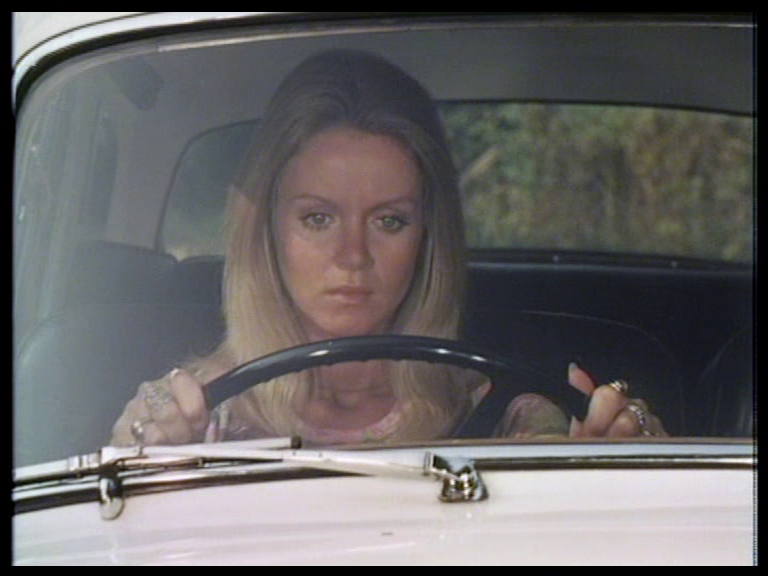
Tracy Conway (Francesca Annis) - romantic but dangerous

Tracy's feminine charm is a key part of the episode's preoccupation with gender. Those viewers with less traditional views are likely to raise eyebrows at much on-screen here. The vision of the sexes presented is far from progressive to contemporary eyes. Tracy is obsessed with romance and pleasing men. In her spare time she reads romantic magazines and sews a wedding trousseau. She even attacks her victims with her sewing scissors! The direction often lingers on her legs and may seem voyeuristic. The men - with the exception of Bill - are more than happy to play up to her. The irony is that Bill is an ardent womaniser but something about Tracy makes him uneasy.

"Girlfinders", the employment agency, is especially anachronistic - it wouldn't even be legal these days. However it's the behaviour of the men running Girlfinders that might most alarm some viewers as they fawn over Tracy while Mr. Seddon even makes a play for her, which she rejects in literally cutting fashion. In another scene even Richard slaps the backside of his secretary Prue, behaviour that would now be construed as harassment although he otherwise conducts himself professionally. Adult women are routinely described as "girls", including by the police officers. It can seem somewhat patronising.

Extra evidence for the "prosecution" might be the feather-headed Sally. Not only is Sally rather dizzy but she falls to pieces around Richard. On the other hand Sally shows much more resilience and sense in opposition to the duplicitous Tracy. The other two female characters though offer some challenge to the stereotypes. Prue, before her brutal demise, is a very able employee who shows no romantic interest in her boss or anyone else. Richard's wife Janice is perceptive and rational.

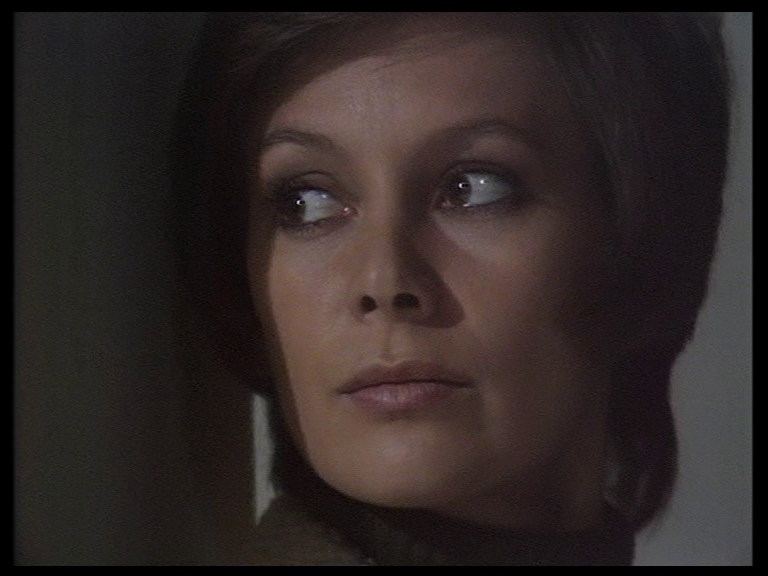
Sally resents the newcomer Tracy but maybe she sees things others overlook

However it is best to see such depiction in context. The early 1970's were not particularly progressive and this is a reflection - albeit exaggerated - of those sexist times. Nor should we be under any illusion that attitudes have completely changed and even now some viewers with watch and see nothing untoward on-screen. It may be that the writing and direction were being rather playful and tongue-in-cheek on the subject of gender. It is wise to realise that attitudes change and at the time of broadcast this would not have struck most viewers as especially contentious or controversial. No doubt a contemporary version of the story would be less stereotypical but what we see here is a depiction of gender of fifty years ago and even those viewers of today who dislike those stereotypes can appreciate it as a reflection of its time; all works reflect the eras and attitudes when they were produced and it is unfair to judge them by the standards of today. 

Leaving aside these wider issues, there is so much to commend here. The story is a very fine one with many highlights, aided by skilful direction by Shaun O'Riordan. The encounter between Prue and Tracy is very well done and in contrast to the teaser the violence is kept off-screen. The office politics between Bill, Sally and Tracy are a real highlight as well. Bill is a funny character although one could imagine he might be less fun to actually work for - especially for a woman. His womanising is hard to take seriously but his suspicions of Tracy are excellently conveyed - a fine performance by Edward Judd. Generally there is an undercurrent of humour that is well-handled. The two junior detectives supply some of it before the much sharper Barnes takes control. Overall the police characters are stronger than usual here. Leaving aside gender issues the only aberration occurs in the form of Mrs. Vinkel - housekeeper to the Carters - where a combination of poor writing (including references to courgettes!), bad costume, bad hair-dressing and awful acting produce possibly the most cringe-worthy scene in the whole of Thriller. Fortunately she is soon gone and the episode thereafter maintains quality and momentum 

The climax of the episode is a fascinating finale and rounded-off with a brilliant final line.  All considered this is one of the most distinctive outings of Thriller, both highly entertaining but provocative in its style. It may not be one of the very best but it makes a lasting and powerful impression.

Notes

This is one of the few Thriller episodes with no American actor or character (and the last but one to do so). However Francesca Annis does play Tracy with something of a transatlantic accent with her character having worked in the Bahamas. There are also favourable references to American employers and qualities in general and some uses of American English e.g. references to a "misrouted call" and "attorney" rather than lawyer. With no American on-screen these touches may have given the episode more of a connection to US audiences.

Monday, September 20, 2021

K Is for Killing - Series 2 Episode 6, Saturday 2nd March 1974 (ITC movie title "Color Him Dead")

The story...

Tycoon David Garrick narrowly escapes an assassination attempt. He is fairly unruffled by this but his playboy son, Sunny, is very concerned. He recruits unconventional private detectives Arden and Suzy Buckley to investigate. David Garrick is pretty unpopular so there is no shortage of suspects. It becomes evident that the prospective killer has hired professionals to do the job who will ruthlessly eliminate those who frustrate their plans. Who wants David Garrick dead - and why?

Review

The most atypical Thriller episode and among the general fan community the least popular. It's fair to say that this comedy-drama instalment centred on a husband-and-wife, wisecracking, cavalier private detective duo is disliked by most who've seen it but I am in the small minority who has always really enjoyed it. Therefore my very positive review comes with a prominent health warning!

Thriller used humour sparingly. This was a deliberate choice as Brian Clemens had shown via The Avengers a talent for combining drama and humour. Thriller did have occasional funny lines or characters like Hans in One Deadly Owner whose dry humour made them amusing. There were also characters of great wit like Matthew Earp (An Echo of Theresa and The Next Scream You Hear) and Hillary Vance (Night Is the Time for Killing). There is also black humour in episodes such as Murder Motel. However nowhere else is there a comedic style as experienced in this outing. The story premise is certainly not comedic - a wealthy businessman is the target of death threats, but from whom? It could easily have been played as an entirely serious whodunit story and it would have been fascinating to see the results. However Brian Clemens (with assistance from Terry Nation with the concept) wrote it as a comedy-drama.

It's fair to say it is the comedy that draws the hackles of most viewers who feel it just doesn't come off. For me on the other hand it works beautifully and is extremely funny. Maybe the problem for some is context. It carries the Thriller brand and viewers expect it to be in similarly intense vein. Maybe viewers seeing the movie version "Color Him Dead" with no knowledge of a link to Thriller might appreciate it more on its own merits. Of course some of them may not rate it even without the Thriller association. The Thriller formula is an elastic one and could stretch to a more humorous style - as an anthology series it did not have to worry about regular characters acting against type and could explore different styles more readily. The key issue is whether that attempt is made successfully.

On a comedic level it works great for me. Arden and Suzy Buckley are a fine pairing, with so many funny lines and a refreshing sense of abandon. They are also though good at their job, thwarting the attempts on Garrick and ultimately catching the killer. Stephen Rea and Gayle Hunnicutt play these entertaining characters with very good chemistry. Sunny is played with great devilish charm by Christopher Cazenove while his father David is appropriately irascible. The criminal broker Shelby Grafton is splendidly handled by Derek Francis - there is general agreement even among sceptics that he is one of the highlights of the episode. The hapless informer Charley White is played almost wholly for laughs and is nicely conveyed by Arthur White. It does say something for the light-hearted style that even Charley's murder is the subject of wisecracking rather than horror. David Garrick's unfaithful girlfriend Mrs. Gale (perhaps a nod to The Avengers and played by Honor Blackman-lookalike Frances Bennett) is another delight, as is the northern hitman who polishes off Charley. It's notable that many of the actors used in this episode were very comfortable with comic and lighter roles which suits the style here but if a more serious version had been attempted quite a few roles may have been recast.

Unconventional private detectives Arden & Suzy Buckley (Stephen Rea and Gayle Hunnicutt)

For all this the drama is not overlooked. The unhappy relationship between Garrick and Sunny is all too real. Garrick has given his son little but money but Sunny has squandered so many advantages - a scenario that exists in many families. The character of Mrs. Garrick though offers the greatest drama. She has mentally collapsed and switches between childish innocence and fearsome bouts of anger - and then back again. Maybe if more use of her role had been made some of the critics might have been appeased. Either way it is a tremendous performance by Jean Kent.

The drama does not go on too long here with the production generally trying to keep matters light. This means for example that even the killing of certain characters or threats to their lives are met quite flippantly in a way that some viewers may feel is hard to take but works for some. As a lighter episode it's not too surprising that it ends on a light-hearted upbeat scene which is a little sickly but okay in this context whereas some attempts to lighten the tone at end of more serious stories (e.g. Kiss Me and Die) jarred rather more. 

There was no return to a production quite like this again. Maybe Brian Clemens and the producers felt it hadn't really worked, or perhaps they were happy with it but believed one such story was enough. Murder Motel at the end of Series 5 saw the return of Derek Francis and had some comic elements but in a more subdued - and rather ineffective - style. Whatever one's opinions on this episode it does at least provide plenty of talking points and hopefully there are others out there who enjoy it.

ITC movie title-watch

The end montage wrongly shows Suzy riding the scooter on which Arden hitches a lift. The new title "Color Him Dead" (using the American spelling of "colour
") perhaps unsurprisingly was assumed to be a spelling mistake by many British newspapers and was "corrected" to "Colour Him Dead". The new title is also one I have to take a few moments to connect it to this episode as it is a very generic title that could refer to various episodes while the American slang use of "color" might be lost on many viewers outside the USA. Better movie titles would have some link to the storyline, e.g. "Death in Small Doses" (the new title for Ring Once for Death) does suggest the villain's mode of killing.

Friday, September 17, 2021

Ring Once for Death - Series 2 Episode 5, Saturday 23rd February 1974 (ITC movie title "Death in Small Doses")

The story...

Roger Masters (Michael Jayston) is a butler employed by widow Laura Vallance (Nyree Dawn Porter). Unknown to her he has already poisoned his last employer. Immediately he is at odds with the existing maid Betty (Clare Sutcliffe) so he frames her for a theft to get her fired, then brings in his girlfriend Lisa (Janet Key) as her more accommodating replacement. The pair slowly poison Laura, aided by a disgraced doctor (Thorley Walters).

Over time Laura becomes sicker and suspicious as Masters cuts her off from outside contact, particularly with her American friend displomat Hugo Fane (Barry Nelson). He also becomes worried by Masters' refusal to let him see her. Masters starts to realise that he is under pressure and the stage is set for some very fateful decisions...

Laura Vallance (Nyree Dawn Porter) tries to get help

Review

This was the first of two appearances in very quick succession by Michael Jayston. No need for whodunits in either case as he is clearly playing a villain from the outset, and both times he is in excellent form. Masters is a great character and an intriguing villain. Behind the very correct exterior lies a truly vindictive and dangerous man. While he is outwardly obedient and concerned about appearances he exudes no genuine warmth at all. Quite how many victims he has chalked up is unclear but without question Laura Vallance is now his target. The motives for his murders may be more complex than they seem. Money seems the obvious motivation but Masters has humble origins and bitterness towards those who squander their advantages. It's possible that behind his outward concern with deference he harbours a hatred of the rich - maybe to the point of psychological damage. This is a rare insight in the show into class tension and would also have been welcome elsewhere.

Masters has no compunction about bullying and manipulating those around him. He is prepared to kill not just his intended victims but also those who get in his way. Even his girlfriend and accomplice Lisa feels his wrath at times and it is unclear how willingly she is involved. 

Nyree Dawn Porter was the big name in this story and gives a strong performance as the unfortunate Laura. She generates great affection for the character who is tricked by Masters. Ultimately she realises the danger but by that time is imprisoned and grievously sick. Her descent into illness echoes that of Tony Mansell in Terence Feely's earlier script for Spell of Evil, albeit this time the cause is rather more prosaic than witchcraft. In both instances the suffering of the victim is a little painful to watch. 

The other British characters are good value. Betty the feisty maid deserves much sympathy for her treatment at the hands of Masters but avoids being a simple victim. She has a neat turn of phrase as well and in the hands of Clare Sutcliffe - who regularly played feisty young woman who push at the boundaries - has a comic, entertaining but also steely edge. Janet Key is very good as Lisa, aptly conveying a character who is in two minds about her activities and seems uncomfortable with the misery she is inflicting. Thorley Walters is highly impressive as Ledworth. Although the doctor is an accessory to murder he is a pathetic character, a shambling, unemployable alcoholic who has no one else to turn to but the ruthless Masters, Rainer displays some sharp wit,  and although it is a fairly small part, he is one of the better Thriller detectives, well conveyed by Victor Winding.

Even Masters' girlfriend Lisa is not safe from his ruthlessness

The American characters probably set the episode back. Barry Nelson (the oldest US guest star seen in the show) gives a decent account as the supportive Hugo Fane but the character is rather bland and sometimes tiresome in his preoccupation with Laura. The reference to his speech on "Arab affairs" is a rare intrusion of politics, although cleverly what side of the fence Hugo was on is never made clear although it is something that Masters is able to use to his advantage. 

Even less effective is his son Piers. The performance of Richard Oldfield as Piers has certainly attracted some criticism. Although that may be a touch excessive it is true that is a rather unconvincing part and the character doesn't really work. Although the principal US actors in Thriller were generally impressive the secondary ones were often less successful. Maybe this part could have been rewritten or recast for better effect.

The climax is impressive, with Masters and Rainer in great form. Just a few months later Michael Jayston was back in the superior A Coffin For the Bride. Maybe this might have met the same standards if, like the later story, it had reserved itself to British characters although the presence of the Americans was key to an American sale as well as giving the show more international appeal. Perhaps the casting of these parts was where things sometimes went awry.


Thursday, September 16, 2021

One Deadly Owner - Series 2 Episode 4 (Saturday 16th February 1974)

The story...

Model Helen Cook is on the way up but her impulsive decision to buy a white Rolls Royce she can barely afford seems peculiar but she felt she "had to have it". Soon after buying it though strange things start to happen. She hears a scream from inside the car and the car drives itself to a remote location far from her intended destination. This and other evidence lead to her to believe the car is somehow connected with a murder but her photographer and boyfriend Peter believes it's all in her imagination and that overwork is leading her to a nervous breakdown. She does investigate with the previous owner - a tycoon called J.P. Jacey. Mr Jacey is rather world-weary and unsettled after his wife disappeared three months earlier. Despite this he hasn't called the police, apparently because she may have left him for another man but maybe there is a more worrying reason for her departure.

Helen Cook (Donna Mills) starts to notice something is very wrong with her car

Review

This is one of those instalments that sharply divides viewers - a huge favourite of some, one of the worst for others. I am very much one of its supporters and it is a contender for my favourite episode, and has been since I first saw it in 1994 on the second ITC video released. Thanks to that video release this will be a contender alongside Someone at the Top of the Stairs for the episode I have seen the most.

One of the oddities was that this was the only outing released on video in its movie format. This was entirely a mistake as the ATV version was available and indeed was broadcast by Bravo in 1996. Some viewers like myself skipped the Bravo repeat assuming the same version would be shown and therefore missed seeing the ATV original until it was released on DVD, Dolphin did quite a decent job on the new titles, with some astute use of clips. The new music ("Gear Shift" by Dave Richmond) was good and worked well. The original teaser, making clear that Mrs. Jacey had been murdered and her body transported in the boot of the Rolls Royce, though was completely excised - the only instance of a whole teaser being removed in the ITC versions. These sorts of cuts are never popular and the teaser was a strong one. Fans feel unhappy about the American producers adding their own "scenes" or animation but cutting from the original, which should be preserved intact, is a step too far. However one consolation of its disappearance, and maybe the logic of Dolphin, is that it created extra mystery about the fate of Mrs. Jacey until the final minutes, although the viewer would always suspect she had been killed. The DVD release though now means that viewers can see both openings.

The story is suitably unsettling and mysterious. Donna Mills became the first star to return to the show and deserves great credit for her performance - a classic Thriller heroine display. Her character generates a lot of affection. The interplay with Jeremy Brett as her partner and arch-sceptic Peter is very impressive. Again the sceptic role is a commonplace one, especially in the supernatural tales, but it is brought off extremely well. The exact nature of the relationship between him and Helen is never wholly clear. They are definitely professionally involved and probably romantically so as well but there is tension. Although much of this resolves around Helen's preoccupation with the car there are also arguments over her desire for independence and this friction creates another dimension to the story. 

This becomes one of the Thriller whodunits with various characters having had previous relationships with Mrs Jacey and seeming to have a motive for killing her. Writing and direction work well to pour suspicion on these figures but they are fine characters in any regard. J.P. Jacey's relationship with his wife leaves many questions unanswered and he appears to be a man with much going on under a very reserved exterior - including maybe a fancy for Helen. Freddy appears to have been another lover of the missing Mrs Jacey and while he seems to be helpful towards Helen can he really be trusted? His open-mindedness provides a neat balance between Helen's suspicions and Peter's scepticism, as does his warmth with Jacey's reserve. He is another of the Thriller charmers with an obvious attraction for Helen but it's suitably reined in on this occasion. Even Hawkins, the very proper butler, looks as if there might be more to him than meets the eye. However it is Hans who steals the show. He is a funny character but in the best style of the show he also exhibits menace and mystery (another former lover of Mrs Jacey as well as a business rival of her husband), and one never feels he is merely a comic diversion. There are a number of fine acting displays but Eric Lander in this role is excellent. 

The final fifteen minutes of the show are tremendous. Great use is made of darkness, contrasted with light from the car or a torch, to create a very creepy atmosphere. The pieces start to come together and the suspects start to move in. The final shot, of Helen's car back up for sale - with the viewer left to speculate on whether its "possession" has now been purged - is a fine resolution to this memorable outing.

Helen Cook finds herself in the spotlight in more ways than one


Wednesday, September 15, 2021

Kiss Me and Die - Series 2 Episode 3, Saturday 9th February 1974 (ITC movie title "The Savage Curse")

The story...

American Robert Stone comes to England searching for his brother who went missing shortly after arriving in a quaint village and meeting a beautiful young woman called Dominie. At the village pub he gets a warm welcome but when he visits Dominie's stately home he gets short shrift from the housekeeper. Fortunately for him Dominie is more welcoming.

An attraction develops between Robert and Dominie but it is uneasy. She has been hurt by what she sees as past rejections. It is also clear that her guardian, a German cum-English "gentleman", Jonathan Lanceford is not keen on the relationship at all. Robert gets the message from other quarters that his presence isn't wanted but he persists. He isn't frightened off even when Fred, a local rat-catcher who had given him some interesting information, dies in a mysterious accident. The signs are that Robert could be next...

Review

This has always been one of my least-favourite Thriller episodes but on my most recent viewing I was more impressed, largely due to a very impressive Part 3. The story premise is certainly promising but the first two parts are maybe somewhat ponderous and don't create as much engagement as hoped. There is an Edgar Allan Poe theme running throughout, with Jonathan Lanceford obsessed with the writer. Creator Brian Clemens suggested this was the closest Thriller came to Hammer Horror - for me that isn't necessarily a plus point although it maybe for some viewers. It's certainly more toned-down than a Hammer movie - not having either the budget or the same liberty for shocking scenes; that need not be a drawback but the earlier sections are perhaps too low-key. Maybe for many viewers this will be remembered as "the one with Jenny Agutter in it" rather than having broader appeal.

However there are virtues which raise this above the ordinary. Most notably the final part is almost wholly set against the background of a party at the Lanceford house and is very well-done, both visually and in terms of themes as the jollity of the colourful fancy dress celebrations contrasts with very dark (literally and metaphorical) events in the recesses of the building. All this leads up to a very dramatic climax and some good special effects, all well-directed by John Sichel. Impressively shot night-time scenes earlier on are another asset.

The performances are, for the most part unremarkable but quite competent. Although the episode is best-remembered for Jenny Agutter - and she gives a typically good account as the unhappy, lovelorn Dominie - it is American guest star George Chakiris as Robert Stone who has much the most to do, appearing in almost every scene. Anton Diffring is impressive as the disconcerting Jonathan Lanceford but his character is not one of the more memorable Thriller villains. Russell Hunter does a good job in a small but key role as the permanently drunk but revealing poacher Fred.

An irritating aspect is the use of unconvincing rural accents in the village pub. This is an echo of the yokel scenes in the village store in A Place To Die, an episode from the previous season, also written by Terence Feely. The viewer knows it is a rural community and the stereotypical accents are unnecessary. On a more positive if trivial note it is refreshing to see a pub full of working-class beer drinkers in a show otherwise dominated by privileged people downing wine and spirits. There is a neat exchange where Robert is asked how they deal with foxes in America. He dryly replies, "Well in our country the foxes shoot back"!

A moment of danger for Robert Stone (George Maharis) & Dominie (Jenny Agutter)

The final scene I find disappointing - although it has a narrative purpose it is lightweight and out of keeping with the very serious action beforehand, in particular detracting from the strong climax.

Overall then a mixed bag. I would recommend checking other instalments of Thriller first but this is still worthy of attention.

Notes

Jenny Agutter was the youngest lead actor in Thriller, aged just 20 when this episode was produced in October 1973. 

This episode features the only car-chase in Thriller although its explanation was more prosaic than in other shows - Jonathan Lanceford was trying to catch-up with Jim Stone to give him a party invitation!

There are some similarities with the later The Next Voice You See - also scripted by Terence Feely - in the way that the final part contrasts a lively party with sinister events elsewhere in the house and in particular the danger facing the hero of the story.

This was the last episode of Thriller broadcast in the UK on terrestrial television when its "movie" verson "The Savage Curse" aired on London Weekend Television at 12.30 am on 30th June 1984 (technically 1st July as it was after midnight). This movie version was also the only one to include a piece of music by Laurie Johnson ("Lonely Stranger") to accompany its new titles.

Tuesday, September 14, 2021

Once the Killing Starts - Series 2 Episode 2 (Saturday 2nd February 1974)

The story...

Oxford Professor Michael Lane is indulging in an affair with one of his young students, Stella. They want to be together, but how? Without Stella's knowledge Michael kills his wife, setting-up an elaborate scheme that makes it seem she has been killed by an intruder while he was meeting a colleague. He is delighted when the plan seems to work, with the police none the wiser.

However somebody knows his secret and he starts to receive disturbing blackmail notes, with the words cut-out of newspapers. His affair continues but he becomes more anxious and suspicious. These suspicions lead to another murder but the notes keep coming. Can he silence his accuser?

Review

This is an episode which is very important in my own Thriller history. It was the first episode I ever saw any part of. This was back in 1982 when I saw around the final ten minutes - it wasn't planned viewing, simply what was on TV when I entered the room. However I was feeling ill at the time and bizarrely saw the programme as an omen and avoided it thereafter! I must stress this was nothing to do with the contents of the episode (which I long remembered) but superstition.

Fast-forward twelve years and two articles by Ian Kerr about Thriller got me intrigued about the show. One of them in the magazine TV Zone featured a striking photograph from the episode featuring a blackmail letter sent to the Professor and I suppose I also found the title and the synopsis fascinating so putting all these elements together it was an instalment I very much wanted to see although in the end it was one of the last I got to view in 2002. This was in its movie version. There is no doubt that the movie versions with their new titles and music have often been panned but I felt those for Once the Killing Starts were wonderfully chilling and really set up the episode well. Perhaps all these factors have contributed to this being one of my top episodes. Objectively there are probably many better and many viewers rank it quite low but sometimes for all sorts of often random personal reasons an episode gets an unusually high or low rating...

This is a fine, very intriguing story. The small cast allows the few characters to be very well-drawn. There are interesting insights into religion rarely seen in Thriller, with the Professor a confirmed non-believer and his wife a devout Catholic. The themes of anxiety and suspicion are very well-developed. All the main cast give strong performances. Patrick O'Neal is very convincing as the Professor. Gerald Sim gives an excellent performance as Petersen who exudes gentlemanly decency, although that doesn't stop Michael suspecting him as well. Quite possibly the best display is by Gary Watson as the enigmatic Inspector Rush. Rush appears to suspect nothing but it is evident he knows much more than he lets-on. Angharad Rees and Michael Kitchen play Stella and George (another student) capably and later became very frequent television faces.

Just what does Inspector Rush (Gary Watson) know of Professor Lane's crimes?

Typically for "Thriller" the direction by John Scholz-Conway is fine but probably even better than normal. There are some very poignant shots of a photograph of the Professor and his wife. There is a "whodunit" element of sorts in the episode in the form of who is the blackmailer and skilful direction and performances give viewers the impression that certain characters are either the blackmailer or know what the Professor has been doing. The ending is absolutely extraordinary. For me it an absolute masterstroke but it is fair to say others have found it quite incredible. It certainly will get you thinking about the vagaries of the human mind! Could such things happen? Watch .. and judge for yourself...

Notes - the Thriller answer (homage?) to Columbo?

There are some interesting parallels between this episode and the American detective series Columbo which was running at the time. There are some similarities in story format. There is a well-to-do villain whose villainy is transparent from the start - the American show rarely did "whodunits" and instead the focus was on what might the killer do next and how he would be caught (the latter far more prominent in Columbo). In both productions we also often see elaborate methods either to commit a murder or to cover it up. In both the detective only appears until fifteen or twenty minutes into the episode after we have seen the villain set-up the crime. This episode ends with a calm, very low-key arrest not unlike those seen  in Columbo and in sharp contrast to the often dramatic climaxes in other Thrillers. The lead actor Patrick O'Neal had even appeared as a villain in Columbo ("Blueprint for Murder" in 1972).

However the greater parallels are between the detectives. In this episode Inspector Rush is unfailingly polite in his enquiries, never giving any overt sign to Professor Lane that he was under suspicion (although little hints are dropped). He is though very persistent and gets under the skin of Lane before at the climax moving in to present the damning evidence. All these were hallmarks of Columbo. Rush also wears a mac at one point although it must be said his appearance is always much more dapper than the dishevelled Columbo!

Was there overt influence? TV writers (of that era anyway) often spoke of being influenced by films and sometimes by theatre, very rarely of being influenced by other TV shows or TV writers. Brian Clemens in particular was very open about the influence of Hitchcock on his work. Writers (and indeed actors and directors) of that era often gave the impression that they watched little or no television but it may still have had some influence. Columbo was a rare beast in the TV world in being both a big success with viewers and critics (who would often be very hard to please with TV shows and could give the impression the medium was beneath them). Therefore it would probably be one of those shows that those in the TV world would be more willing to make an exception for and possibly be influenced by. Of course resemblances between shows can occur for many reasons which are often coincidental, or some in the production may be "channelling" the spirit of a particular show while others are not. Whatever the reality it is fascinating to speculate on the links, actual or potential. Columbo had already done a rather mediocre episode set in the UK ("Dagger of the Mind" from 1972) and this with a little adaptation would have probably served rather better as a script, even running about the same screen length as most episodes of the American show.


Monday, September 13, 2021

Only a Scream Away - Series 2, Episode 1 (Saturday 26th January 1974)

The story...

Samantha and Robert Miller have just got married, the wedding only spoiled by an unpleasant prank in which someone splashed red paint on Samantha's dress, As they settle down to married life they are befriended by an American neighbour called Howard Heston, an amiable if slightly odd man who often talks fondly of childhood memories. Things take a dramatic turn for the worse when Robert is killed in a car crash and soon afterwards Sammie's aunt Liza dies in another accident of carbon monoxide poisoning. Sammie is unsurprisingly devastated and now it seems Howard is all she has....

Review

One of the most popular episodes and quite deservedly so. It is something of a mystery why a Times reviewer of the day argued with regard to it, "The series has already murdered itself"!

This was another Terence Feely script (based on a story by Brian Clemens as indeed was every Thriller script not written by him) and is one of his best - an excellent choice to premiere the second series in January 1974 in the UK. Maybe the story moves rather slowly, particularly in its first half, but that does serve to develop character and an atmosphere of unease. 

There are no great surprises in the story - the quality is in the execution. It is evident from his first appearance that Howard Heston is to be the villain, despite his great, deceptive charm. There is, as Aunt Liza says, something "odd" about him. However what intrigues the viewer is what exactly is his secret and what is he going to do? Lots of things come together to make Heston one of the best Thriller villains. Good writing is key, and the direction is splendid. However the performance of Gary Collins, making the first of his three appearances in the show, is decisive. Gary is in top form, especially in the final fifteen minutes. It would be easy for the character, with his obsession with childhood, to seem silly or incredible but the balance is just right. One ends up pitying such a man who has clearly lost touch with reality. All the same he is a dangerous and frightening figure. The scenes with him whistling "Mona Lisa" while playing cat's cradle are especially haunting. This echoed another sinister use of a popular tune in the case of "Greensleeves" in Possession.  The shot of him early on (viewed from the neck down) cutting up the photograph of Samantha is also very disturbing.

Hayley Mills was one of the best-known performers to figure in Thriller and is very good as the winsome Samantha. As a classic "English rose" Hayley was ideal for a British heroine. She has a demanding role, with difficult emotional scenes to play, but does not disappoint. Again she really comes into her own in the final part in the long scene at Heston's windmill. Joyce Carey, well-known at the time as the scatter-brained mother of Patrick Glover in the sitcom Father, Dear Father deserves commendation for her part as Aunt Liza. Unlike Samantha Liza does sense danger, something that Heston does not appreciate. 

The sight of David Warbeck as Robert is welcome after his two appearances in the second block of UFO as a Skydiver captain and he equips himself well in a more substantial role. The only character that doesn't wholly work is that of Tom (Jeremy Bulloch). Tom is rather annoying in the first part, particularly with his innuendoes, but as tragedy heaps on Samantha he adopts a more serious and effective guise.

Howard Heston (Gary Collins) unloads his anguish to Sammie (Hayley Mills)

The final minutes are extremely strong as more is understood of Sammie and Heston's childhood relationship, The use of the photographs of the pair as children is a superbly unnerving technique. Director Peter Jefferies cleverly flashes between shots of the photos and Samantha, as he also does with a card from Giles (Howard's real name) when she finally and realises his real identity. These rapid switches are very unsettling. The photos do though reveal an appreciable age gap between the two when they were children that makes their friendship surprising, although perhaps Giles / Howard's interest in a much younger child was already a signal that something was not quite right with him. This leads up to a dramatic climax which rounds off a great start to the second series.

Notes

Some synopses of the TV movie version repeats in the early 1980s referred to Howard Heston as a "former mental hospital inmate". This was never stated on screen but may have been referred to in script directions or information supplied to broadcasters. It is certainly a plausible background for him but probably wisely it wasn't mentioned on-screen as it could well have alerted other characters including Sammie and Robert that Heston was not all he seemed.

Gary Collins was along with Donna Mills the only American guest star to appear in three episodes of Thriller. While all her parts were as heroines (as was commonly the case with the US guests) he played transparent villains on all three occasions. These villainous parts though were all rather different: a mentally-disturbed fantasist in this episode; a hard-nosed, calculating man who wants his wife killed in The Double Kill; and a con-man in Dial a Deadly Number.

By coincidence this episode featured two actors born in New Zealand - David Warbeck and Jonathan Elsom - although both were playing British characters.

Ronald Mayer - playing a doctor on this occasion - was the first actor to reappear in Thriller.

ITC Movie version title-watch

The opening titles feature a ludicrous and tasteless sequence in which a doll is throttled and injected with a syringe. The end title artwork shows Howard Heston pointing a gun, although no gun was seen in the episode. A fine musical piece called "Mask of Fear" by Jack Trombey does offer some redemption.


The American influence on Thriller

Although Thriller was a British TV series one of the most striking aspects is the strong American influence upon the show. indeed this was ...