Showing posts with label analysis of Thriller. Show all posts

Tuesday, January 25, 2022

Thriller and Realism

Thriller was not a series that aimed for social realism and - as the title suggested - it was aimed pretty squarely at producing "thrills" without linking them to social commentary or issues such as inequality or injustice. It didn't set its stories in the kinds of environments that would be familiar to most viewers of the time such as terraced housing, council flats or estates or even semi-detached, lower middle-class homes in the suburbs as had been done to some degree with the earlier suspense series Shadows of Fear. Instead Thriller set its tales in broadly the homes and workplaces of the ultra-affluent.  

Social class

Predominantly the central characters in Thriller are - at the least - solidly middle class and some are bordering on upper class. Where money problems exist they are restricted to needing more to fund an opulent lifestyle rather than struggling to pay the bills. A few of them live in more modest accommodation - the students Chrissie and Gillian living in a bed-sitting house in Someone at the Top of the Stairs are the most prominent example - but even these are middle class in aspiration and culture. Most live in large, very well-appointed houses - often in the countryside - or in very smart flats. Many of the lead characters have servants. They often seem to have independent or inherited wealth or own their own businesses. Wine or spirits (often poured from expensive decanters) are routinely drunk with beer-drinking reserved for those from more modest backgrounds.

The Marshalls' flat in The Next Victim - an example of the very comfortable living of most Thriller characters

Working class characters are seen sparingly in Thriller and often work in jobs such as deferential servants, caretakers, cleaners and taxi drivers. Their relationship to their middle class counterparts (often their employers or those they otherwise serve) are generally harmonious with little sign of class conflict or tension. Regional accents are rare in the show and with a tendency to highlight "Cockney" voices rather than those from elsewhere. This included a lack of accents or characters from Scotland, Wales or Ireland. Received pronunciation or distinctly "posh" voices were dominant. Altogether then, Thriller was a show set within an upper middle class English culture. 

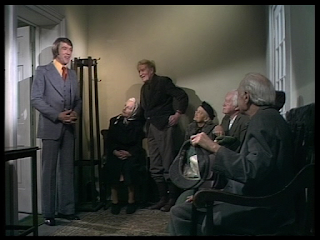
Reg Lye twice played a caretaker in Thriller (here in Spell of Evil), each time overseeing a strangely-deserted office

The depiction of this very affluent world though was quite commonplace on British film and television at the time, certainly in dramas other than those with explicitly social realist or issue-raising aims. This was probably even more pronounced in shows like Thriller which were aiming to reach international audiences. Such programmes have tended to focus on a particular version of England (the other nations of the UK rarely covered) - an upper, middle class society with an over-representation of rural life. Other sections of society are not criticised but simply largely absent. The same was true of most classic literature, theatre and art. It might be argued that while this was a narrow and stereotypical image of Britain it was the one that "travelled best". The dominance of received pronunciation or "posh" voices was also considered more accessible to international viewers than characters speaking with regional accents, dialects or slang. Even the inclusion of working class "Cockney" characters might be seen as more familiar to non-UK viewers than other sections of the working classes who have been much less depicted in productions for international sale. No doubt viewers in other nations could argue that depictions of them in British or other productions are similarly narrow or stereotypical. 

Leaving aside international considerations, it might be argued that this focus on "high society" was the one most likely to appeal to viewers including those from modest backgrounds. Perhaps viewers find watching scenes set in very affluent settings or very attractive rural environments more appealing. Perhaps they see it as escapism, or even enjoy the contrast between the characters' opulent lives and the deadly threats around them, Rural settings might be seen as having more potential to strike fear due to their isolation. Social realist films and TV are often still very popular (including in some soap operas) but viewers may prefer to separate them from genres such as thrillers. Some thrillers and suspense series such as Shadows of Fear had set some of their stories in more humble settings but maybe the broadest audience appeal comes from taking the approach Thriller did. 

The isolated country house (seen here in Possession - a common Thriller setting

Ethnicity

Black or Asian characters are scarcely seen at all in Thriller. Two appear in the entire show - both briefly in the The Colour of Blood - one as a passenger and the other as a train cleaner.

This absence may seem quite remarkable and unrealistic. Although numbers were lower than today, the black and Asian population in the UK in the early 1970s was not insignificant. However the location of so many Thriller stories does offer some explanation. Many of them were set in the Home Counties or rural areas where ethnic minorities even today are in small numbers. The stories set in London might have offered more opportunity but the characters featured were predominantly the wealthy middle-classes who at that time - and to a large degree now - were overwhelmingly white.

The lack of ethnic minority characters may then seem a reflection of the setting of the stories. Even so the very low numbers seen are perhaps a little surprising. However - once again - context is the key. This lack was commonplace in TV and film productions of the time. The only exceptions tended to be shows taking race as their theme or story and a few comedies that focused on racial conflict, sometimes in very unsubtle and dubious ways. It is only in the last few years that black and Asian characters have figured more frequently.

Gender - this is covered in an earlier blog

Age

Children were scarcely seen in Thriller (this was generally the case in adult dramas) but otherwise characters of all ages appeared. However heroines and victims (or potential victims) were predominantly young. This focus on youth in particular relation to victims amplified feelings of vulnerability and poignancy at such loss of life.

Sally Thurston in Someone at the Top of the Stairs, about to become one of many young female victims in the show

Disability

Disabled characters were at the centre of three Thriller episodes - The Eyes Have It, The Next Voice You See and The Next Victim. The first two of these focused on blindness and the third on a woman who was a wheelchair-user. In the latter two instalments the focus is very much on the danger posed to the disabled character who fears for their life with a killer on the loose. Disability as a source of vulnerability which a villain seeks to exploit has featured in various thriller-type productions (including Brian Clemens's earlier film Blind Terror) and the lack of ability to see a threat or mobility to get away from it are obvious sources of fear. The Eyes Have It offers a notable variation as the blind students are not the targets of the villains who are instead trying to assassinate from distance a visiting statesman but they are still vulnerable and their efforts to thwart the attack do put them in danger. 

The other major disabled character featured in the show is Charley Harrow in Nurse Will Make It Better. Charley was left paralyzed after a riding accident and struggles not just physically but psychologically with her new condition. Her angry outbursts ultimately lead to the engagement of nurse Bessie Morne as her carer - a fateful decision as Bessie is actually a witch who effects a "miracle cure" as a means to turn Charley towards evil. A blind flower seller is also briefly featured in The Colour of Blood in which he has a carnation stolen from him by serial killer Arthur Page. This limited attention to disability was common at the time with disabled characters generally only featured where their disability was seen as the source of a storyline.

Some of the blind students in The Eyes Have It

Marriage

Although marital breakdown was much less common in the early 1970's, marriage has a remarkable resilience in Thriller. Only in one episode (The Double Kill) is there significant friction between a married couple. In a few others spouses are planning to dispatch their partners although their marriages seem contented, even to the prospective victims. Where characters have lost their spouses it is usually through death rather than divorce or separation. The handful of figures who are divorced or separated - the Garricks (K Is for Killing) and Greg Miles (If It's a Man - Hang Up!) - have something of a cloud hanging over them. There are no instances of cohabitation.

The police

One of the most striking aspects of Thriller is its depiction of the police. While police and detective shows regularly highlighted the police as heroes, their portrayal in Thriller is notably ambivalent. Most certainly there are some officers who are very incisive and professional. Some such as those seen in Kill Two Birds appear to be cut from the rather rougher, more socially realistic cloth used in The Sweeney. However the majority of Thriller policemen are in some way eccentric or significantly flawed. Quite a number of them make mistakes and some border on the unprofessional in their conduct.

Contrasting detectives in The Double Kill - the unconventional (or unscrupulous) Lucas (Peter Bowles) and more conventional Sergeant Player (John Flanagan)

This means that in some respects the depiction of the police in Thriller may be more realistic than that seen in most other series. They are shown - alongside their virtues - as having human foibles and limitations that the hero or heroine often has to compensate for.  Maybe there was a deliberate attempt to get away from the heroic, often cliched portrayal. Whatever the reason it is a provocative and engaging aspect of the programme.

Sexuality

This is largely covered in the modesty section of The American Influence on Thriller (to follow). Thriller certainly does not have a realistic depiction of sexuality. Married couples are rarely seen in bed together and even then not in any intimate scenes. They also always wear modest nightdresses or pyjamas in the bedroom. Gay and lesbian characters are non-existent, but that was true of all but the most ultra-realist drama of the time.

A married couple in modest night-wear - Ray and Penny Burns in Possession

Violence

This is probably the most unrealistic aspect of Thriller. Characters are routinely stabbed or shot without a single wound appearing on their body. A number of murder scenes are rather unconvincingly done. This is especially true of those involving victims being run down by cars. In these and some others the victims seem to freeze and make things remarkably easy for their assailants.

The lack of blood seen in the show, and the unrealistic nature of the violence, may well have been a deliberate decision. Achieving realistic violent scenes can be demanding to act, direct and produce. It may mean the choreographing of a struggle, extensive use of make-up or effects and delays to achieve convincing results. The producers may have felt time and resources could have been better used, and they were almost certainly right. A bigger reason may have been to avoid problems with broadcast and viewer reaction. Graphic and realistically violent scenes may upset or offend viewers and may result either in censorship or later broadcast time.

Overall Thriller's use of violence was essentially theatrical, like many aspects of the programme. The priority was to create psychological tension and leave violence in the viewer's imagination. The lack of realistic violence may put off some contemporary viewers, especially younger ones, but it is one of the most appealing things for the vast majority of fans.

Wednesday, January 19, 2022

Thriller, Realism and Gender - an Analysis

Around two-thirds of characters seen in Thriller were male and arguably they were the ones who tended to "drive" the action, particular as heroes and villains (female principal villains were limited in the show although there were a few others who were accomplices of their male partners). However more broadly the depiction of men and women was very traditional and stereotypical. Men often owned their own businesses and all the male characters were in jobs generally done by men - none broke gender-norms in employment, Many Thriller women were housewives and those with outside employment were usually doing typically female jobs such as secretarial work. Some of them were wealthy through their families / inheritance but very few of them were in high-paying jobs. Three of those worked in the fashion industry, two of them as models and one as a designer. Another was theatrical designer Stella McKenzie in A Coffin for the Bride. The only female character who held a high-paying, high-status job often done in that age by men was lawyer Jennifer Peel (The Next Scream You Hear) and she was killed-off in the opening minutes.

Model Helen Cook (Donna Mills) in One Deadly Owner

Gender stereotypes and inequalities passed largely without criticism in Thriller. In Possession Penny Burns even warmly noted to her husband Ray that she had "promised to obey", Women predominantly seem accepting of gender differences. The term "Women's Lib" was mentioned in a number of episodes but almost always derisively by a male character who was annoyed by a woman who wanted to assert herself more. There was though one overtly feminist character in the form of Suzy Martin in If It's a Man - Hang Up!. Suzy was a model - a role that might seem at odds with challenging traditional views on gender - but despite this she wrote for a feminist magazine and asserted her views and independence despite the snide remarks and dismissals of the men around her. 

As regards female villains, these did break to some degree from stereotypes of women as passive, law-abiding and non-aggressive. However most of these did still fulfil some stereotypes of femininity such as the obsessive romantic Tracy Conway in Sign It Death who even attacks victims with her sewing scissors! Other female villains made use of their attractiveness and sexuality to entrap men. One such example was witch Clara Panton in Spell of Evil. Clara had a long past throughout history and her modus operandi seemed to be captivating men, marrying them then killing them off. This would thereby make her the only female villain who seemed to be a serial killer of men although her past exploits weren't depicted on-screen so this is a little speculative. Tracy Conway is also a serial killer but is prepared to kill both men and women she sees as obstacles to the man she desires. Many male villains are depicted as being very strong or physically skilled to kill their victims but only one woman in the show fitted that description - she was very adept at martial arts and dispatched at least one victim in that manner.  

Clara (Diane Cilento) working her evil spell on her husband in Spell of Evil

Female villains who did not exploit their attractiveness or sexual magnetism were few and far between in the show. The most obvious was the rather androgynous witch Bessie in Nurse Will Make It Better. However she was still fulfilling a female role as a witch and two of the Harrow sisters who fell under her spell did exploit their female allure to entrance men. There was perhaps only one female villain (seen in Murder Motel) who proved to be mastermind behind the murderous operation and who didn't seem to trade on femininity or sex appeal but her role was a small and low-key one.

The witch Bessie (Diana Dors) in Nurse Will Make It Better

Much attention has been paid to the role of women as victims - or potential victims - in Thriller. The great majority of episodes revolved around male villains who targeted women - either individual women or women in general. Several - including famous outings such as The Colour of Blood - focused on male serial killers of women although most of these villains (serial or otherwise) were prepared to kill men as well if they got in their way. In some instances women (usually the heroine) were not the original targets but end up being pursued when they discovered the villain's plans, e.g. Abby in Won't Write Home Mom - I'm Dead. In others women were the victims seen on-screen although it's unclear if they were being targeted in general or if it were just a coincidence, e.g. Good Salary - Prospects - Free Coffin

Most victims of homicide are men so the strong focus on women as victims wasn't realistic in that sense although it was in showing them as victims of men. However this focus isn't unusual across the thriller / suspense genre. Some female viewers did say that the show made them nervous  and sadly in society female worries about the risk of being attacked by males are common. However the focus on women as victims in Thriller and similar productions is probably related to the vulnerability factor. Such shows (and novels) probably provoke more tension when the victim seems particularly vulnerable compared to the villain and a male villain targeting women does this more than a man threatening a man, a woman targeting a man or even a woman targeting another female. Other forms of vulnerability often form the basis of thrillers including potential victims who are disabled or placed into a lonely, vulnerable position or alien situation. Three Thriller episodes indeed focused on disabled potential victims while the Brian Clemens film And Soon the Darkness (a precursor to Thriller) explored the vulnerability of tourists in a foreign land who knew little of the native language. Often these figures were also female to intensify the fear factor although The Next Voice You Hear provided an interesting gender reversal in focusing on a blind man who was being being targeted by a villain. His female assistant Julie also played a vital role in supporting and protecting him.

Blind pianist Stan Kay (Bradford Dillman) with his assistant Julie (Catherine Schell) in The Next Voice You See

Related to the focus on women as victims is the focus on heroines and the two are linked as villains would target heroines, sometimes because they had discovered their activities. Heroines in Thriller were almost always young and very attractive; they were also often blonde and American although the latter characteristic was largely related to American funding for the series. More broadly the heroines were notable for their perceptiveness and alertness to danger - indeed they would generally be far quicker to spot danger than the male characters, including the heroes, Often their suspicions would meet with scepticism or even ridicule from others but ultimately be proved right. Their sense that "something is wrong" might be seen as related to the common (arguably stereotypical) idea of "female intuition". However other women in the show were less able to see the warning signs and others were notably complacent and often ended up as victims.  

The heroines showed impressive bravery in facing up to the villains when it would have been understandable if they had backed away, and their enquiries were vital in tracking them down and ultimately defeating them. However it was notable that in almost all cases they still required physical help from men - usually the heroes, sometimes the police - to save them in a final confrontation. They may have had perceptiveness, persistence and courage but an ability to defend themselves and physically overcome villains was limited. This wasn't though unusual in productions of the time and those women with self-defence or combat skills were generally in short supply. One notable example in Thriller was a plain-clothes policewoman in Screamer who was very adept in subduing and arresting a man who tried to sexually assault her. However this was not such a radical portrayal as the use of a tall, very attractive young woman might have been more to make an impression on male viewers while her towering over Detective-Inspector Charles might also have offered more of a humorous than a serious effect. In general at that time those few women who were able to physically overcome men were still very physically attractive and even their physical strikes were done with what might be considered "feminine grace", e.g. dancing-type kicks rather than punches. Other than this officer, women were virtually absent in police roles in Thriller and all the detectives depicted were men.

Plain-clothes policewoman (played by Carinthia West) in Screamer - breaking gender stereotypes?

Overall women were portrayed in Thriller in a rather traditional and arguably stereotypical manner. This portrayal wasn't unusual for the time although it probably was more traditional than in other shows and certainly so compared to social realist programmes. it must be borne in mind though that Thriller was made almost fifty years ago and while gender inequalities are far from defeated today they were far more prevalent, deep-rooted and often taken for granted back in the 1970s. It was not progressive in its depiction of gender or many other issues but it certainly wasn't an outlier at the time and should be judged in context. It reflected the times in which it was made and it is certainly possible to appreciate Thriller (and many other shows of the time) without endorsing its views (or possible views) on gender and other matters. 

Friday, January 7, 2022

Thriller and Formula - Heroes, Heroines and Villains

Thriller was not intended to be a radical piece of television and like so many shows made use of certain standard formulae. The term "formula" is not intended in a negative sense - formula is more akin to the "rules of the game" or maybe a set of typical ingredients to a production. Following a formula (tightly or loosely) doesn't make something good or bad - what matters is the skill with which it is used.

Common oppositions found in Thriller were:

Hero / Heroine Vs Villain

Hero / Heroine Vs Victim

Villain Vs Victim

Not all episodes featured these kinds of oppositions or broad character-types. All featured villains and victims but in a few there is no obvious hero or heroine. A number of character types can be identified.

The hero

The hero uses his wit and skills (often physical) to overcome the villain. He risks his life to achieve justice. Although there is some risk of him being transformed into a victim he usually is more than able to look after himself. Often the Thriller heroes are not the central characters but are partners or friends of the heroine. For part of the story they have a tendency to overlook warning-signs spotted by the heroine but later on they become convinced and help her to track down the villain and save her from danger - Dr Bruce Nelson in A Place To Die (below) offers a good example of this, being much slower than his wife to spot the danger in the village but later on realising she is right and going out to save her. Some heroes though (often those who are police officers or detectives such as Matthew Earp in An Echo of Theresa) - perhaps because of their profession and training - are "on the ball" from the beginning as well as demonstrating physical bravery when confronted.

Dr Bruce Nelson (Bryan Marshall), at this point failing to spot the sinister behaviour of the villagers

The heroine

There are some similarities to the above but there is an important sex difference in Thriller and many other shows. The heroine is distinguished by her perceptiveness and courage. She is remarkably alive to danger signs and this both increases her chances of survival but also of bringing the villain to justice. For all her resourcefulness though she often relies on a man (usually the hero, sometimes the police) to save her from death at the hands of the villain. The heroine teeters on the brink of becoming a victim but her skills and the attentions of the hero save her. Remarkably often in the show the heroines were young, blonde American women - Donna Mills very much fitted these characteristics and played the heroine role in three episodes starting with Someone at the Top of the Stairs (below).


The villain

The common factor behind all the Thriller villains is their willingness to kill and / or inflict suffering. However there are crucial differences among villains in background and motivation. Some are psychopaths but many more are greedy or vindictive. Some clearly have disturbed backgrounds and profound mental illnesses which may mitigate their actions and in some instances have led to them being classed as insane and committed to secure mental institutions rather than prisons (Terry Spelling in Killer With Two Faces indeed escaped from such a place).

Arthur Page (played by Norman Eshley) in The Colour of Blood - one of the most memorable Thriller villains

American guest performers were not often cast as villains although remarkably Gary Collins came over to play villains on three occasions! However in the last of these he didn't play a traditional Thriller villain (i.e. a killer) but instead a con-man with the episode (Dial a Deadly Number) featuring another character who most definitely was prepared to kill. 

The victim

Victims are a varied bunch though united by their deaths at the hands of the villains. Some are utterly unfortunate, simply in the wrong place at the wrong time. Others stray into danger by failing to read clear warning signs. The complacent victim is a common type. While the hero or heroine (usually the latter) is alive to danger, the victim frequently lacks such perceptiveness. Other victims are alert to danger but dispatched by the villain before they can raise the alarm. Unlike the hero or heroine they lack the skill or luck (or star billing!) to survive.

Formula in storylines

All Thriller episodes are, in some way, about villains prepared to kill. There are two basic storylines. In the "whodunit", the killer is not known until the climax of the story (e.g. File It Under Fear). In others the killer is clearly identified from the beginning and the story revolves around his or her murderous behaviour and ultimate comeuppance. As traditional and moral productions the killer always has to be caught in some way.

The "whodunits"

At least three suspects would be presented, with strong clues highlighting them as suspects. The actual killer would normally have faced limited suspicion until the climax of the episode. He or she may have seemed a pillar of goodness or been an apparently innocuous minor character. The killer is never though a previously unseen character, so the viewer does his or her deduction work among those who have appeared on screen. In no instance would the killer prove to be "the obvious suspect". This does mean that a fairly perceptive viewer can rule out some of the candidates although the ultimate culprit may still be a surprise.

It must be stressed that the use of such a formula is not necessarily a problem. Some viewers may not like it but many do, their satisfaction deriving from how the formula is used.

The known killer

Many of the episode (such as The Colour of Blood noted above) take this format. There are still many unknowns such as how many will fall victim, which characters will succumb, and in what fashion. As mentioned above victims will often be drawn from the ranks of the complacent or those who raise the alarm but don't have star billing!.

"Natural justice"

The central villains in Thriller always get their comeuppance and face some kind of justice. This rarely means an on-screen court appearance. Like most crime dramas Thriller is concerned with apprehending or neutralising the villain, not with the process of trial or imprisonment. In only two episodes is a court verdict delivered and in one of these it is at the start of the action rather than to round off the story. The viewer knows that the villain is guilty so apprehension is seen as ending the story, with the trial process a fait accompli. This is true of many crime dramas including police / detective series in which the capture or death of the villain ends the narrative with the courtroom / legal dramas tending to deal with trials or raising issues about whether a defendant might be guilty or not. 

On quite a number of occasions the villain is killed rather than captured. Usually this is by the hero, or rarely the heroine, in self-defence. Sometimes the villain's death occurs accidentally in a struggle. Occasionally it is rather more legally dubious, where self-defence might be hard to justify. The death of the villain, which occurs in many other productions and related genres, is seen as "natural justice" or "poetic justice"- the deserved fate of a killer - and therefore not likely to trouble the viewer. This may seem uncomfortable to some but this is fiction and entertainment and viewers who enjoy such "comeuppance" and "natural justice" on screen usually recognise the need for formal justice in reality.


Two episodes do break this pattern. In one the villain is seemingly left to die in a sealed room by the heroine. Although certainly not legally justifiable her actions might seem consistent with natural justice. The other is a more striking departure in which one killer kills their partner in crime before themselves being killed by a hitman. The hitman is certainly not motivated by any sense of justice or even trying to avenge a terrible crime but his action in a sense "square the circle": two killers are dead and the viewer may feel they have received their just deserts whatever the motives of those who killed them. For all that, the episode ends with the hitman free, quite probably to kill again. However what Thriller did not do was end an episode with the killer of an "innocent victim" on the loose and having apparently evaded justice. In this sense it was consistent with the vast majority of crime dramas and which therefore makes them seem very moral narratives in which wrongdoers do not escape justice - legal or "natural" - for their crime.

The last minute reprieve

Thriller, like so many shows involves climaxes where the villain, about to kill a defenceless victim, is thwarted at the last minute. This may even be just as they are about to strike the decisive blow. Occasionally it is the hero or heroine who has to be saved by the police or others but normally heroes or heroines don't need others to save them and are, by definition, not helpless. That less applies to heroines who may need the hero or the police to save them.

The final battle

Another common climax is for the hero / heroine to defeat the villain in a final battle or confrontation. Sometimes the villain is subdued or captured after a struggle, on other occasions he or she is killed.

Men supporting women

This commonly happens in climaxes in both a literal and metaphorical sense. Most usually it occurs in a last-minute reprieve when the hero saves the heroine or female victim from death at the hands of the villain. The tearful or distressed  woman is then cradled by her saviour. Very rarely a woman supports a man. This generally reflects the convention, dominant in Thriller, that women, for all the wit they may show, ultimately need a man to support and save them.

Other conclusions

In one episode the heroine is saved from an attack by her husband - ironically - by a serial killer who despite his murderous behaviour targets other woman and has grown protective of her There are some more low-key conclusions where the villain is captured or made to surrender without a major confrontation - usually instances where the hero has cut-off any chance for them to escape or has the potential to use force to subdue them. In all these cases though there is still a final encounter and the villain is still caught and brought to book. These became very common in the final episodes, maybe in a deliberate attempt to break from more typical endings. 


Friday, December 31, 2021

Actors in Thriller - episodes and characters

This is a list of all the actors who appeared in Thriller with their episode and character name also noted.  Years of birth and death are predominantly from the Internet Movie Database which is an excellent source for further career details on them. Actors who appeared in more than one episode are indicated in bold. 

Abineri, John (1928-2000) Good Salary – Prospects – Free Coffin (Insp. Bruff)

Adams, Dallas (1947-1992) Won’t Write Home Mom – I’m Dead (Douglas Sadler)

Agutter, Jenny (1952-  ) Kiss Me and Die (Dominie Lanceford)

Allan, Andrea (1946- ) The Next Victim (Janet Cunningham)

Allen, Patrick (1927-2006) Sign It Death (Richard Main)

Anders, Derek In the Steps of a Dead Man (Sgt. O’Hara)

Anderson, Georgine (1928-2024)  A Place to Die (Jane)

Anderson, Keith  (d. 2007) Murder Motel (Auditor)

Angelis, Paul (1943-2009) If It’s a Man – Hang Up! (Terry Cleeves)

Anholt, Tony (1941-2002) A Midsummer Nightmare (Johnny Baxter)

Annis, Francesca (1945- ) Sign It Death (Tracy Conway)

Anthony, Philip (d. 2020) Spell of Evil (Mr. Todd)

Appleby, James (1923-2014) K Is for Killing (Brett)

Armstrong, Alun (1946- ) The Eyes Have It (Mike)

Arnatt, John (1917-1989) Sign It Death (Mr. Robinson)

Atkinson, John  (1921-2007) Kiss Me and Die (Ben Hawkes)

Aubrey, Skye (1945-2020) In the Steps of a Dead Man (Grace Worth)

Aylen, Richard (1925-1990) Possession (Insp. Miles)

Bailey, John (1914-1989) Kill Two Birds (Kemp)

Baker, Carroll (1931- ) The Next Victim (Sandy Marshall)

Ball, Ralph (1925-2003) Killer with Two Faces (Dr. Styles)

Bannen, Ian (1928-1999) Won’t Write Home Mom – I’m Dead (Frank); Death in Deep Water (Doonan)

Barron, Keith (1934-2017) Good Salary – Prospects – Free Coffin (Charley Masters)

Bate, James (1945-1992) Sign It Death (Detective)

Bateman, Stephen (1920-2012) Screamer (Station Master)

Bates, Ralph (1940-1991) Murder Motel (Michael Spencer)

Baxter, Keith (1933-2023) Nightmare for a Nightingale (Tony Risanti)

Baxter, Trevor (1932-2017) Where the Action Is (Winters)

Beadle, Jo  (1947-) If It’s a Man – Hang Up! (Girl Friday)

Beatty, Robert (1909-1992) Sleepwalker (Dan Summers)

Beaumont, Richard (1961-2023) Only a Scream Away (Heston as a child)

Beint, Michael (1925- ) One Deadly Owner (Hawkins)

Belcher, David  (1939- ) Spell of Evil (Peterson)

Benjamin, Christopher (1934-2025) In the Steps of a Dead Man (Medical Officer)

Bennett, Frances (1930-2014) K Is for Killing (Mrs. Gale)

Bennett, Harold (1899-1981) A Place to Die (Old man); The Next Victim (Blind man)

Bennion, Alan (1930-2018) Sign It Death (Mr. Carter)

Benson, Martin (1918-2010) The Next Victim (Spiros Lemke)

Bergen, Polly (1930-2014) An Echo of Theresa (Suzy Hunter)

Berwick, James (1929-2000) Where the Action Is (“Daddy” Burns)

Billa, David  Lady Killer (Waiter)

Bishop, Ed (1932-2005) Nurse Will Make It Better (Carson)

Blanck, Carmen (1909-1983) Sign It Death (Mrs. Vinkel)

Blanch, Dennis (1947- ) Dial a Deadly Number (Paul Kirby)

Blessed, Brian (1936- ) A Midsummer Nightmare (Det. Sgt. Briggs)

Boa, Bruce (1930-2004) Good Salary – Prospects – Free Coffin (Hanley)

Boden, Anthony (1937-1995) File It under Fear (Sgt. Frost)

Bond, Derek (1920-2006) The Next Scream You Hear (Maycroft)

Bond, Sue (1945- ) File It under Fear (Karen)

Boswall, John (1920-2011) Lady Killer (Old Man)

Bowles, Peter (1936-2022) The Double Kill (Supt. Lucas)

Breck, Julia (1941-2020) K Is for Killing (Samantha)

Brennan, Kevin (1920-1998) Come Out, Come Out Wherever You Are (Parminter)

Brett, Jeremy (1933-1995) One Deadly Owner (Peter Tower)

Bromley, Sydney (1909-1987) A Place to Die (Seth)

Brook, Faith (1922-2012) In the Steps of a Dead Man (Betty Cornfield)

Brooke, Meriel  (1932- ) An Echo of Theresa (Theresa Merrow)

A.J. Brown (1897-1978) The Colour of Blood (Judge);

Brown, Candida  Only a Scream Away (Samantha as a child)

Brown, Edwin (d. 1999) Nightmare for a Nightingale (Theatre manager)

Browning, Alan (1926-1979) The Crazy Kill (Supt. Brook)

Buckley, Denise (1945- ) In the Steps of a Dead Man (Sheila Howes)

Bulloch, Jeremy (1945-2020) Only a Scream Away (Tom Manners)

Burke, Paul (1926-2009) An Echo of Theresa (Brad Hunter)
Burnham, Edward (1916-2015) Night Is the Time for Killing (Minister)
Byrne, Michael (1943-2026) If It’s a Man – Hang Up! (Richard Lovell)
Byrnes, Edd (1933-2020) Where the Action Is (Eddie Vallance)

Ian Bannen in Death in Deep Water. He also appeared in Won't Write Home Mom - I'm Dead

Caesar, John (d. 2020) An Echo Of Theresa (Second Taxi Driver)

Cahill, Theresa (1944- ) Nightmare For a Nightingale (Anna's singing voice)
Cain, Shirley (1935- )
K Is For Killing (Mrs. Terril)
Carey, Joyce (1898-1993) Only a Scream Away (Liza Meredith)
Carne, Judy (1939-2015)
Someone At the Top Of the Stairs (Gillian Pemberton)
Carr, Darlene (1950- )
Sleepwalker (Katey Summers)
Carson, John (1927-2016)
Possession (Ray Burns); Come Out, Come Out, Wherever You Are (Arthur Lewis)
Casillas, Peter
Kiss Me And Die (Jim Stone)
Cater, John (1932-2009)
If It's a Man - Hang Up! (Murchison)
Cavendish, Brenda (1947- ) 
The Next Victim (Betty)
Cazenove, Christopher (1945-2010)
K Is For Killing (Henry "Sunny" Garrick)
Chakiris, George (1934- )
Kiss Me And Die
Challis, John (1942-2021)
Sleepwalker (Peter)
Chamberlain, Martin If It's a Man - Hang Up! (Young Policeman)
Chancer, Norman
Good Salary - Prospects - Free Coffin (Police Driver)
Charlton, Alethea (1932-1976)
Someone At the Top Of the Stairs (Mrs. Oxhey)
Chase, Catherine
The Eyes Have It (Jenny)
Chater, Geoffrey (1921-2021)
The Colour Of Blood (Michael Graham); The Next Voice You See (Sir Peter Hastings)
Chinnery, Dennis (1927-2012) 
The Crazy Kill (Sergeant)
Cilento, Diane (1932-2011)
Spell Of Evil (Clara Panton)
Coats, Athol (1918-1974) 
Possession (Filson)
Coda, Frank (1931- )
Where the Action Is (Pusell)
Coleman, Richard (1930-2008)
A Coffin For the Bride (Weston)
Collins, Gary (1938-2012)
Only a Scream Away (Howard Heston); The Double Kill (Hugh Briant); Dial a Deadly Number (Dave Adams)
Collins, Laura
Someone At the Top Of the Stairs (Sally Thurston)
Connor, Patrick (1926-2008)
I'm the Girl He Wants To Kill (Freddy)
Conti, Tom (1941- )
If It's a Man - Hang Up! (Bruno Varella)
Corbet, Richard
Someone At the Top Of the Stairs (Chauffeur); Come Out, Come Out, Wherever You Are (Michael Reeves)
Corcoran, Michael
The Colour Of Blood (Blind Flower Seller)
Cork, Charles
Nightmare For a Nightingale (Stage Hand)
Cossins, James (1933-1997)
Possession (Kellet)
Courtenay, Margaret (1923-1996)
A Coffin For the Bride (Claire Jameson)
Cowan, Gerry (1933-2003) 
Death To Sister Mary (TV Director)
Cronin, Michael (1942- ) 
If It's a Man - Hang Up! (Advertising Man)
Cronyn, Tandy (1945- )
The Crazy Kill (Tracy Loxton)
Cross, Larry (1913-1976)
Where the Action Is (Tommy Vaughan)
Crosthwait, Julie (1951- ) 
Good Salary - Prospects - Free Coffin (Tall Blonde)
Culver, Michael (1938-2024)
Nurse Will Make It Better (Simon Burns)
Cunningham, Linda (1953- ) 
Spell Of Evil (Suzy)
Cusack, Sinead (1948- )
The Eyes Have It (Sally)


Daker, David (1935-2026)
Kill Two Birds (Charley Draper)
Damon, Stuart (1937-2021)
Nightmare For a Nightingale (Hal Bridie)
Daniel, Jennifer (1936-2017)
Spell Of Evil (Liz)
Darby, Kim (1947- )
Good Salary - Prospects - Free Coffin (Helen Terek / Masters)
Davies, Griffith
The Double Kill (Burglar)
Davies, Rachel
The Next Voice You See (Nancy)
Davies, Windsor (1930-2019)
Death To Sister Mary (Det. Moore)
Dawes, Anthony (1928-2021)
One Deadly Owner (Car Salesman); Nightmare For a Nightingale (Doctor)
Day George, Lynda (1944- )
Come Out, Come Out, Wherever You Are (Cathy More)
De Keyser, David (1927-2021) 
Someone At the Top Of the Stairs (Cartney)
De Souza, Edward (1932- )
Spell Of Evil (Tony Mansell)
Delamain, Aimee (1906-1999)
Night Is the Time For Killing
Delaney, Thom
A Midsummer Nightmare (Detective)
Denise, Gita (1924-2004)
Nightmare For a Nightingale (Marie)
Dennis, Jonathan
Killer With Two Faces (Intern)
Dermott, Patsy
The Next Victim (Barbara)
Dexter, William (d.1974)
Spell Of Evil (Mr. Pritchard)
Diamond, Marion (1936-2026) 
The Next Scream You Hear (Jennifer Peel)
Diffring, Anton (1916-1989)
Kiss Me And Die (Jonathan Lanceford)
Dillman, Bradford (1930-2018)
The Next Voice You See (Stan Kay); Death In Deep Water (Gary Stevens)
Dobtcheff, Vernon (1934- )
An Echo Of Theresa (Bannerheim)
Donahue, Patricia (1925-2012 )
Once the Killing Starts (Elizabeth Lane)
Donnelly, Elaine (1948- )
Sleepwalker (Esme)
Dorning, Robert (1913-1989)
Murder In Mind (Dr. Arthur Sammers)
Dors, Diana (1931-1984)
Nurse Will Make It Better (Bessie Morne)
Drake, Gabrielle (1944- )
Kill Two Birds (Tracy)
Dunham, Joanna (1936-2014)
Possession (Penny Burns)
Dury, Susan (1946- ) 
Killer With Two Faces (Jenny); Good Salary - Prospects - Free Coffin (Babs Bryant)
Dyneley, Peter (1921-1977)
K Is For Killing (David Garrick)

Eagles, Leon (1932-1997) Sign It Death (Mr. Seddon)
Edwards, Glynn (1931-2018)
A Place To Die (Lob)
Elliott, Denholm (1922-1992)
The Crazy Kill (Dr. Henson)
Elliott, Peter (d.1975)
Kiss Me And Die (The Effigy)
Ellison, Christopher (1946- )
Kill Two Birds (Tosher)
Elsom, Jonathan (1938- ) 
Only a Scream Away (John Stratford)
English, Arthur (1919-1995)
A Coffin For the Bride (Freddy)
Eshley, Norman (1945-2025)
The Colour Of Blood (Arthur Page)
Etherington, Colin
If It's a Man - Hang Up! (Peter Marnley)

Farmer, Suzan (1942-2017) Death In Deep Water (Gilly)
Faye, Janina (1949- ) Good Salary - Prospects - Free Coffin (Wendy Phillips)
Fearn, Sheila (1940- ) Sign It Death (Prudence Clare)
Feldon, Barbara (1932- ) Lady Killer (Jennifer Frifth / Tanner)

Fenemore, Hilda (1919-2004) The Double Kill (Mrs. Harper)
Fisher, Colin (1944-2011)
File It Under Fear (Sgt. Truscott)
Fisk, Martin
The Next Victim (Mr. Sheldon)
Flanagan, John (1947- )
The Double Kill (Michael Player); Kill Two Birds (Wilson)
Flannery, Susan (1939- )
Nightmare For a Nightingale (Anna Cartell)
Fletcher, Barrie
Only a Scream Away (Det.Sgt. Sullivan)
Flint, John (1929-1987)
A Place To Die (Police Inspector)
Flower, Gilly (1908-2001) 
K Is For Killing (Miss Cardiff)
Flynn, Eric (1939-2002)
A Killer In Every Corner (Slattery)
Forbes, Scott (1920-1997)
Someone At the Top Of the Stairs (Mr. Patrick)
Forbes-Robertson, (1928-2008) John
The Next Voice You See (Dr. Mace)
Fowlds, Derek (1937-2020)
Death To Sister Mary (Dicky)
Fox, Marcia (1943- ) 
A Coffin For the Bride (Connie)
Foxe, Celia (1949-) 
The Next Voice You See (Party Guest)
Francis, Derek (1923-1984)
K Is For Killing (Shelby Grafton); Murder Motel (Sam)
Francis, Jan (1951- )
File It Under Fear (Gilly Randall)
Franklin, Pamela (1950- )
Screamer (Nicola Stevens); Won't Write Home Mom - I'm Dead (Abby)

Derek Francis in Murder Motel; he also appeared in K Is for Killing


Gabriel, John (1914-1998) A Place To Die (Dr. Oliver Sharp)

Galloway, Jack (1947- ) Possession (Young Man)
Gardner, Jimmy (1924-2010)  Sign It Death (Caretaker)
Garvin, John
In the Steps Of a Dead Man (Mr. Howes)
Gatrell, John (1907-81)
Death In Deep Water (Butler)
Geddis, Peter (1937-2018) 
The Next Voice You See (Jameson)
Gee, Donald 
(1937-2022) Murder In Mind (Tom Patterson)

Geeson, Judy (1948- ) Night Is the Time For Killing (Helen Marlow)
Gelder, Ian (1949-2024) 
The Next Victim (Small)
George, Bisi
The Colour Of Blood (Train Cleaner)
George, Christopher (1929-83)
The Next Scream You Hear (Bernard Peel)
Gerard, Alan (1929-2009) 
The Next Victim (Mr. Firth Benham)
Giovannini, Rita (1950- )  
Kill Two Birds (Carrie Draper)
Glennie, Alison (1957- ) 
A Midsummer Nightmare (Annabel Tully)
Glover, Julian (1935- )
Good Salary - Prospects - Free Coffin (Gifford)
Glynn, Paddy (1939- ) 
The Next Voice You See (Party Guest)
Graham, Sonia (1929-2018)
Sign It Death (Mrs. Carter)
Gray, Charles (1928-2000)
Night Is the Time For Killing (Hillary Vance)
Greatrex, Christina
Murder In Mind (Jill Pembury)
Greene, James (1931-2021)
Killer With Two Faces (Policeman); Good Salary - Prospects - Free Coffin (PC Breck)
Greif, Stephen (1944-2022)
Kiss Me And Die (Ben Groom); Nightmare For a Nightingale (Tramp)
Grout, James (1927-2012)
File It Under Fear (Superintendent Cramer)
Gurpinar, Gigi
The Colour Of Blood (Woman On Train)
Gwillim, David (1948- )
If It's a Man - Hang Up! (Henry "Hal" Venner)
Gwynn, Michael (1916-76)
A Coffin For the Bride (Oliver Mason)

Hagon, Garrick (1939- ) The Colour Of Blood (Peter)

Haigh, Colin I'm the Girl He Wants To Kill (Messenger Boy)
Haines, Brian (1921-91)
The Crazy Kill (Inspector)
Haley, Paul
The Next Victim (Doctor)

Hall, Michael Screamer (Doctor)

Hallam, John (1941-2006) Murder Motel (Roscoe)
Hallett, Neil (1925-2005)
The Next Voice You See (John Pelham)
Hampshire, Susan (1937- )
Kill Two Birds (Sally)
Hampton, Richard (1937- ) 
A Coffin For the Bride (Sergeant Miles)
Hardiman, Hilary 1933-1991) 
Possession (Cecily Rafting)
Hardwicke, Edward (1932-2011)
The Next Scream You Hear (Gifford)
Harper, Gerald (1929-2025)
If It's a Man - Hang Up! (Greg Miles)
Harrison, Felicity (1946- ) 
The Next Victim (Mrs. Adams)
Havers, Nigel (1951- )
The Next Voice You See (Ludovic Bates)
Hawser, Gillian
Good Salary - Prospects - Free Coffin (Babs Two)
Hay, Alexandra (1947-1993)
A Place To Die (Tessa Nelson)
Haythorne, Joan (1915-87)
Death To Sister Mary (Mother Superior)
Held, Karl (1931- )
Good Salary - Prospects - Free Coffin (Security Guard)
Henderson, Don (1932-97)
A Killer In Every Corner (Boz)
Hendry, Ian (1931-84)
Killer With Two Faces (Bob / Terry Spelling)
Henson, Basil (1918-90)
An Echo Of Theresa (Charles Merrow)
Herbert, George
Sleepwalker (Pearson)
Hill, Charles (1906-1981) 
Someone At the Top Of the Stairs (Policeman)
Hill, Peter (1932-1995)
Good Salary - Prospects - Free Coffin (Filing Clerk); Nightmare For a Nightingale (Purvell)
Hill, Rose (1914-2003)
File It Under Fear (Mother)
Holderness, Sue (1949- )
If It's a Man - Hang Up! (Betty)
Holley, Bernard (1940-2021)
Come Out, Come Out, Wherever You Are (Paul Eastman)
Holloway, Anthea (1919-2002)
The Next Voice You See (Party Guest)
Holness, Bob (1928- )
One Deadly Owner (Radio Announcer)
Hooker, Trisha
I'm the Girl He Wants To Kill (Young Woman)
Horner, Penelope (1939- ) 
The Double Kill (Clorissa Briant)
Horovitch, David (1945- )
The Crazy Kill (Tredgett)
Horsley, Bill
Night Is the Time For Killing (Waiter)
Hoskins, Bob (1942-2014) Kill Two Birds (Sammy Draper)
Howell, (1919-2015) Peter
Screamer (Ward)
Hoyland, William (1943-2017) 
Kill Two Birds (Turner)

Hume, Roger (1940-1996)
An Echo Of Theresa (Dr. Korner)
Humpoletz, Paul (1943- ) 
Murder Motel (Osgood)
Hunnicutt, Gayle (1943-2023)
K Is For Killing (Suzy Buckley)
Hunter, Russell (1924-2004)
Kiss Me And Die (Old Fred)

Susan Hampshire with Bob Hoskins in Kill Two Birds

Innes, George (1938- ) Where the Action Is (Zac)

Jackman, Godfrey (1924-2014) The Colour of Blood (Policeman)

Jackson, David (1934-2005) The Eyes Have It (Martin)
James, Gerald (1917-2006)
Sign It Death (Barnes)
James, Lawrence (1927-1986) 
Death in Deep Water (Police Inspector)
Jayston, Michael (1935-2024)
Ring Once for Death (Roger Masters); A Coffin for the Bride (Mark Walker)
Jeffrey, Peter (1929-1999)
Come Out, Come Out, Wherever You Are (Dexter)
Job, William (1930- ) 
An Echo Of Theresa (Trasker)
Johnson, Richard (1927-2015)
Murder in Mind (George Drew)
James, Barry
Kiss Me and Die (Tom Whidden)
Jones, Freddie (1927-2019)
A Midsummer Nightmare (Arnold Tully)
Jones, Gemma (1942- )
Dial a Deadly Number (Helen Curry)
Jones, Ken (1930-2014)
I'm the Girl He Wants To Kill (Sam)
Jordan, Desmond (1922-2009)
Sleepwalker (Telstan)
Jordan, Patrick (1923-2020)
Murder Motel (Inspector Turner)
Judd, Edward (1932-2009)
Sign It Death (Bill Lewis); Murder Motel (Charles Burns)

Michael Gwynn and Michael Jayston in A Coffin for the Bride

Kaufman, Maurice (1928-1997) The Next Victim (Derek Marshall)
Kaye, Lila (1929-2012)
A Place to Die (Bess Tarling)
Kendall, Cavan (1942-1999)
Dial a Deadly Number (Tim Foster)
Kent, Jean (1921-2013)
K Is For Killing (Mrs. Garrick)
Key, Janet (1945-1992)
Ring Once for Death (Lisa)
Kinney, Tiffany
Nurse Will Make It Better (Suzy Harrow)
Kirek, Milos (1946-1993)
Night Is the Time for Killing (Ivan Malov)
Kitchen, Michael (1948- )
Once the Killing Starts (George Newton); Sleepwalker (Ian)
Kneale, Patricia (1925-2008)
Spell of Evil (Mrs. Mansell)

Lacey, Ronald (1935-1991) The Next Victim (Bartlett)
Laird, Jenny (1912-2001)
A Place To Die (Nan)
Lamb, Charles (1900-1989)
Dial a Deadly Number (Caretaker)
Lampson, David
Murder In Mind (PC Peters)
Landen, Dinsdale (1932-2003)
An Echo Of Theresa; The Next Scream You Hear (Matthew Earp)
Lander, Eric (1924-1999)
One Deadly Owner (Hans)
Lang, Robert (1934-2004)
I'm the Girl He Wants To Kill (The Man)
Lankesheer, Robert (1914-1993)
The Next Voice You See (Foster)
Lawson, Leigh (1945- )
Death To Sister Mary (Larry Turner)
Le Mesurier, John (1912-83)
File It Under Fear (Mr. Stubbs)
Lees, Michael (1927-2004)
The Eyes Have It (George Mullard)
Leigh-Hunt, Ronald (1916-2005)
Nightmare For a Nightingale (Giles Turner)
Lewis, Rhoda (1933- )
Someone At the Top Of the Stairs (Emma Patrick)
Lewis, Richard (1914-90)
Nightmare For a Nightingale (Tony's singing voice)
Liles, Linda
Nurse Will Make It Better (Charley Harrow); Dial a Deadly Number (Ann Curry)
Linden, Jennie (1939- )
Death To Sister Mary (Penny Stacy)
Linder, Cec (1921-92)
Nurse Will Make It Better (Edgar Harrow)
Line, John (1931-2018) 
Come Out, Come Out, Wherever You Are (Davis)
Lipman, Maureen (1946- )
File It Under Fear (Liz)
Littledale, Anabel
Won't Write Home Mom - I'm Dead (Helen)
Lodge, David (1921-2003)
Killer With Two Faces (Bradley)
Longhurst, Jeremy (1931-2001)
Spell Of Evil (George)
Lord, Basil (1913-79)
Sleepwalker (Parsons)
Lye, Reg (1912-88)
Spell Of Evil (Caretaker); Good Salary - Prospects - Free Coffin (Caretaker)
Lynley, Carol (1942-2019)
If It's a Man - Hang Up! (Suzy Martin)
Lynton, Annette (1953- ) 
The Next Voice You See (Claudia Hastings)

MacKriel, Peter (1934- ) A Coffin For the Bride (Porter) Murder Motel (Mr. Taylor)
MacLeod, Robert (1915-2004)
Night Is the Time For Killing (Henry Marlow)
Magee, Patrick (1924-82)
A Killer In Every Corner (Professor Carnaby)
Maharis, George (1928-2023)
Death To Sister Mary (Mark Fields)
Malcolm, Christopher (1946-2014) 
Won't Write Home Mom - I'm Dead (Hank)
Mallory, Kathleen
Come Out, Come Out, Wherever You Are (Jane Howard)
Mann, Andrew
The Next Scream You Hear (Garfield)
Marcovicci, Andrea (1948- )
Nurse Will Make It Better (Ruth Harrow)
Marioni, Ray (1933- ) 
One Deadly Owner (Waiter); Where the Action Is (Croupier)
Markham, Petra (1947- )
A Killer In Every Corner (Helga Muller)
Marlowe, William (1932-2004)
The Eyes Have It (Jefferies)
Marsh, Robert
In the Steps Of a Dead Man (Military Policeman)
Marshal, Anna
Death In Deep Water (Hotel Receptionist)
Marshall, Bryan (1938-2019)
A Place To Die (Bruce Nelson)
Mason, Eric (1927-2010)
The Colour Of Blood (Policeman)
Mason, Max (1940-2015)
The Next Victim (Tom Packer)
Mason, Raymond (1924- )
Kiss Me And Die (Bill Gurney)
Maxwell, James (1929-1995)
Good Salary - Prospects - Free Coffin (Carter)
May, Bunny (1940-2017)
Kill Two Birds (Freddy)
Mayer, Ronald (1916-1980) 
Lady Killer (Minister); Only a Scream Away (Dr. Lambert)
Mayne, Belinda (1958- )
The Next Scream You Hear (Boutique Assistant)
McBride, Hazel (1949- )
Killer With Two Faces (Nurse)
McCann, Donal (1943-1999)
Screamer (Jeff Holt)
McClelland, Allan (1917-1989)
Murder Motel (Lee)
McCormack, Colin (1941-2004)
The Eyes Have It (Peter)
McCutcheon, Gillian (1939- ) 
Murder Motel (Janice Freeman)
McGrath, Brian (1943-2010)
Someone At the Top Of the Stairs (John Elgar)
McGreevy, Oliver (1928-1981) 
Where the Action Is (Henry)
McKenna, TP (1929-2011 )
Lady Killer (Jack Hardisty); The Next Victim (Frampton)
McMillan, Roddy (1923-79)
Killer With Two Faces (Inspector Filory)
McMillan, Susannah
Killer With Two Faces (Dorothy)
Melville, Georgina (1949-2004) 
File It Under Fear (Jackie)
Merrick, Simon
The Next Scream You Hear (Doctor)
Meyer, Hans (1925-2020)
The Next Scream You Hear (Karl Vorster)

Millan, Robyn (1949-2020) Murder Motel (Kathy)
Miller, Lynne (1951- )
Murder Motel (Young Couple - Woman)
Mills, Donna (1940- )
Someone At the Top Of the Stairs (Chrissie Morton); One Deadly Owner (Helen Cook); Killer With Two Faces (Patty Heron)
Mills, Hayley (1946- )
Only a Scream Away (Samantha Miller)
Mirren, Helen (1945- )
A Coffin for the Bride (Stella McKenzie)
Mitchell, Norman (1918-2001)
Death to Sister Mary (Security Man); The Double Kill (Man In Pub)
Moreno, Juan (1939- )
A Place to Die (Mad Nick); The Crazy Kill (Filton)
Morley, Donald (1923-1999)
Kill Two Birds (Dexter)
Morris, Beth (1943-2018)
Dial a Deadly Number (Sally Kirby)
Morris, Robert (1940- ) 
One Deadly Owner (Freddy)
Morris, Wolfe (1925-1996)
Screamer (Balsam)
Mortimer, Francis
K Is For Killing (Young Man)
Morton, Hugh (1903-1984)
A Coffin for the Bride (Judge)
Mutton, Roger (1942- ) 
The Next Voice You See (Jeremy)

TP McKenna with Ian Gelder in The Next Victim. He also appeared in Lady Killer

Nash, Anthony (1915-1977) Night Is the Time for Killing (General)
Nelson, Barry (1920-2007)
Ring once for Death (Hugo Fane)
Neve, Suzanne (1939- ) 
The Next Scream You Hear (Blonde); Won't Write Home Mom - I'm Dead (Beryl)
Newlands, Anthony (1926-1995)
Death to Sister Mary (Tony Barton)
Nichol, Stuart (1908-1981) 
Sign It Death (Commissionaire)
Nicholson, Paul
The Double Kill (Man In Pub)
Nielson, Claire (1937-2026)
The Crazy Kill (Hillary)
Nightingale, John (1943-1980)
File It Under Fear (Steve Kerroway)
Nolan, John (1938-2026)
In the Steps Of a Dead Man (Marty Fuller)
North, Lesley
Won't Write Home Mom - I'm Dead (Janet Sadler)
Norton, Jim (1938- )
Screamer (The Man)

Oates, Robert I'm the Girl He Wants To Kill (Constable Winters)
O'Callaghan, Richard (1940- )
File It Under Fear (George)
Oldfield, Richard
Ring Once For Death (Piers Fane)
O'Neal, Patrick (1927-94)
Once the Killing Starts (Professor Michael Lane)
O'Neil, Colette (1935-2021)
Come Out, Come Out, Wherver You Are (Alice Lewis)
Oxley, John
The Next Voice You See (Robert Carroll)

Palance, Holly (1950- ) The Next Voice You See (Suzy Kay)
Palmer, Christina
Good Salary - Prospects - Free Coffin (Helen Two)
Parkinson, Robin (1929-2022) 
Killer With Two Faces (Mr. Holland)
Parrish, Clifford (1919-2013) 
Someone At the Top Of the Stairs (Harold Thurston)
Parry, Ken (1930-2007)
The Crazy Kill (Taxi Driver)
Patrick, Diana
Won't Write Home Mom - I'm Dead (Jody)
Payne, Laurence (1919-2009)
One Deadly Owner (John Jacey)
Pearce, Jeremy (1924?- )
Sign It Death (Sergeant)
Pedley, Anthony (1944- ) 
A Midsummer Nightmare (Charley Spencer)
Peel, Eileen (1903-81)
Sleepwalker (Suzy)
Pendrey, Richard (1944-2006)
File It Under Fear (Gerry Masters)
Perllman, Dawn (1947- ) 
Kill Two Birds (Hairdresser)
Pettet, Joanna (1942-2026)
A Killer In Every Corner (Sylvia); A Midsummer Nightmare (Jody Baxter)
Phillips, Dorothea (1928- ) 
The Next Victim (Mrs. Firth Benham)
Phillips. Neville (1927- ) 
An Echo Of Theresa (Bar Waiter)
Philpotts, Ambrosine (1912-80)
Screamer (Lady)
Piper, Jacki (1946- )
Night Is the Time For Killing (Bride)
Pitt, Ingrid (1937-2010)
Where the Action Is (Ilse)
Porter, Nyree Dawn (1936-2001)
Ring Once For Death (Laura Vallance)
Porter, Sarah (d. 2018) 
Won't Write Home Mom - I'm Dead (Emma)
Powell, Robert (1944- )
Lady Killer (Paul Tanner); Death To Sister Mary (Charles Rook)
Preston, Duncan (1946- ) 
Night Is the Time For Killing (Groom)
Pritchard, Reg (1925-2013) 
Night Is the Time For Killing (Attendant)

Robert Powell with Jennie Linden in Death To Sister Mary

Quayle, Jenny (1950- ) File It Under Fear (Betty)

Radd, Ronald (1929-76) Murder In Mind (Superintendent Terson)
Ramskill, Herbert (1913-1977) 
The Colour Of Blood (Train Guard)
Randolph, Elsie (1901-1982)
A Midsummer Nightmare (Mrs. Fitch)
Rapley, John (1935-2016)
Nurse Will Make It Better (Dr. Ward)
Rawlinson, Howard
Lady Killer (Hotel Clerk)
Rea, Stephen (1946- )
K Is For Killing (Arden Buckley)
Read, Martin (1944- ) 
Good Salary - Prospects - Free Coffin (Timothy Bryant)
Redford, Ian (1951- ) 
The Next Voice You See (James Townsend); Sleepwalker (Barnstaple)
Redmond, Moira (1928-2006)
Sign It Death (Janice Main)
Rees, Angharad (1944-2012)
Once the Killing Starts (Stella Mason)
Reid, Margo
The Next Victim (Laura Lemke)
Rennie, Maggie (1919-2017) 
Death to Sister Mary (Housekeeper)
Richards, Ted
An Echo of Theresa (First Taxi Driver)
Ridley, Arnold (1896-1984)
A Place To Die (Old Man)
Roberto, Alan
Someone At the Top Of the Stairs (Jonathan Patrick)
Roberts, Ivor (1925-99)
Lady Killer (Doctor)
Robinson, Sue
Kiss Me And Die (Jenny)
Robson, Anne
In the Steps Of a Dead Man (Mrs. Howes)
Rodbert, Mark
A Coffin For the Bride (Young Lad)
Rodway, Norman (1929-2001)
A Midsummer Nightmare (Peter Ingram)
Ruddock, John (1897-1981)
A Midsummer Nightmare (Williams)
Russell, Iris (1922-2014)
Spell of Evil (Mrs. Roberts)
Rutter, Anne (1939- ) 
Murder Motel (Helen Spencer)

Angharad Rees with Michael Kitchen in Once the Killing Starts

Salkilld, Gordon (1927-2003) The Double Kill (Fingerprint Man)

Sands, David The Eyes Have It (Tom)
Saunders, John (1921-1992)
Killer With Two Faces (Man)
Saxton, Granville (1948- ) 
Kill Two Birds (Farrow)
Scace, Norman (1916-93)
Won't Write Home Mom - I'm Dead (Bank Cashier)
Schell, Catherine (1944- )
The Next Voice You See (Julie Gordon)
Schofield, Katharine (1939-2002)
The Colour Of Blood (Julie)
Schofield, Leslie (1938- ) 
The Eyes Have It (Moore)
Schofield, Peter (1928-2003) 
Dial a Deadly Number (J.O'Hara)
Selby, Tony (1938-2021)
I'm the Girl He Wants To Kill (Mark Tanner)
Settelen, Peter (1951- )
A Killer In Every Corner (Tim Hunter)
Severne, Mary Ann
Possession (Young Woman)
Sewards, Terence (1938- ) 
The Next Voice You See (Alan Richards)
Shakepeare, Jill
Death To Sister Mary (Operator)
Sharp-Bolster, Anita (1895-1985)
The Next Victim (Mrs. Bluther)
Sharpe, John (1920-1992)
Kiss Me And Die (Jack Woolbridge)
Shaw, Beatrice (1908-1995)
If It's a Man - Hang Up! (Old Lady)
Shaw, Christine (1932-2003) 
Killer With Two Faces (Woman)
Shergold, Adrian (1948- ) 
Murder Motel (Young Couple - Man)
Sim, Gerald (1925-2014)
Once the Killing Starts (Peterson)
Sinclair, Peggy (1946- ) 
Kiss Me And Die (Miss Faversham)
Smilie, Jim (1944- ) 
Night Is the Time For Killing (Bob Mallory)
Smith, Derek (1927-2023)
The Colour Of Blood (Baverstock); Screamer (Insp. Charles)
Smith, Oliver
K Is For Killing (Marcus)
Smith, Ray (1936-1991)
The Next Voice You See (Ben Tamplin)
Sommars, Julie (1942- )
I'm the Girl He Wants To Kill (Ann Rogers)
Sone, Roy (1939- )
The Colour Of Blood
Stainton, Michael (1934-2022)
The Colour Of Blood (Policeman)**; The Double Kill (Brent)
Stanton, Barry (1940- )
Sign It Death (Sgt. Quinn)
Steedman, Tony (1927-2001)
A Coffin For the Bride (Detective Quilly)
Steel, Anthony (1920-2001)
I'm the Girl He Wants To Kill (Mr. Burton)
Stephens, Sally (1947-2006)
A Place To Die (Jill)
Stone, Philip (1924-2003)
Death In Deep Water (Burton)
Sutcliffe, Clare (1943-2018)
Ring Once For Death (Betty)
Sutton, Dudley (1933-2018)
Kill Two Birds (Gadder)

Tafler, Sydley (1916-1979) Nightmare For a Nightingale (Sam Meadows)

Taylor, Jeffrey A Coffin For the Bride (Warder)

Taylor, Larry (1918-2003) An Echo Of Theresa (Sagar)
Terris, Malcolm (1941-2020)
The Colour Of Blood (Det-Supt.)
Tewson, Josephine (1931-2022)
A Coffin For the Bride (Yvonne Tully)
Thorson, Linda (1947- )
Lady Killer (Toni Tanner)
Tobias, Oliver (1947- )
Won't Write Home Mom - I'm Dead (Alan Smerdon)
Todd, Richard (1919-2009)
The Next Scream You Hear (George Tulliver)
Tong, Jackie (1951- )
Sign It Death (Sally Wilson)
Tracey, Stan (1926-2013)
The Next Voice You See (Pianist)
Tracy, Susan (1945- ) 
I'm the Girl He Wants To Kill (Telephonist)
Troughton, Patrick (1920-1987)
Nurse Will Make It Better (Lyall)
Tull, Patrick (1941-2006)
Murder Motel (Terry)

Turner, John (1932- ) A Place To Die (Bart)

Valentine, Anthony (1939-2015) The Crazy Kill (Garard)

Vaughan, Peter (1923-2016) The Eyes Have It (Anderson)
Vernon, Richard (1925-1997)
In the Steps of a Dead Man (George Cornfield)
Villiers, James (1933-1998)
The Double Kill (Paul)

Peter Vaughan with Sinead Cusack and Michael Lees in The Eyes Have It

Wagstaffe, Elsie (1899-1985) A Place To Die (Old Woman)
Walker, Angela
The Eyes Have It (Pat)
Walker, Harry
Screamer (Sergeant)
Walker, Zena (1934-2003)
Murder in Mind (Betty Drew)
Wall, Max (1908-1990)
A Killer in Every Corner (George Kesselheim)
Wallace, Hedger (1927-2000) 
The Next Voice You See (Party Guest)
Wallis, Francis (1947- )
Someone at the Top of the Stairs (Gary Masters)
Walters, Thorley (1913-91)
Ring Once for Death (Dr. Ledworth)
Warbeck, David (1941-97)
Only a Scream Away (Robert Miller)
Ward, Bill
A Place To Die (Job Fairfax)
Warner, Richard (1911-1989)
Dial a Deadly Number (Baxter)
Waterman, Dennis (1948-2022)
The Eyes Have It (Frank)
Watson, Gary (1930- ) 
Once the Killing Starts (Inspector Rush)
Watson, June (1935- ) 
Murder Motel (Petra)
Webster, Harry (1915-1999) 
Sleepwalker (Hopcroft)
Weir, Molly (1910-2004)
Come Out, Come Out, Wherever You Are (Miss Pendy)
West, Carinthia
Screamer (Policewoman)
Weston, Diana (1953- )
Death in Deep Water (Helen Wiles)
Weston, Graham (1944- ) 
A Place To Die (Dan)
White, Arthur (1933- )
K Is For Killing (Charley Wilson)
White, Frances (1938- )
Screamer (Virna Holt)
Whitehead, Geoffrey (1939- )
I'm the Girl He Wants To Kill (Keston)

Wickham, Jeffrey (1933-2014) Night Is the Time For Killing (Parker)
Wilde, William (1940- ) 
The Next Voice You See (Party Guest)
Williams, Jane (1939-2015) 
Sleepwalker (Louise)
Williams, Suzannah
Where the Action Is (Maid)
Williams, Wendy (1934- )
Nurse Will Make It Better (Mrs. Fuller)
Williamson, Alister (1918-1999)
Night Is the Time For Killing (Barkley)
WIlson, Alan (1923- )
Nurse Will Make It Better (Mr. Fuller)
Wilson, Lewis (1920?-2000?)
A Place To Die (Policeman)
Wilson, Seretta
Killer With Two Faces (Sara)
Wilson, Stuart (1946- )
The Double Kill (Max Burns)
Wimbush, Mary (1924-2005)
Lady Killer (Mrs. Bradley)
Winding, Victor (1929- )
Ring Once For Death (Det.-Sgt. Rainer)
Wing-Davey, Mark (1948- )
The Crazy Kill (Cater)
Wood, Peggy-Ann (1912-98)
A Place To Die (Belle)
Woolfe, Betty (1901-1982) 
An Echo Of Theresa (Cleaner)
Woollett, Annette
I'm the Girl He Wants To Kill (Penny); Good Salary - Prospects - Free Coffin (Wendy Two)
Wright, Terry
Once the Killing Starts (Det-Con Waters)
Wyldeck, Martin (1914-1988)
Spell Of Evil (Mr. Laker)
Wylie, Frank (1935-94)
The Next Scream You Hear (Hendry)
Wylton, Tim (1940- )
The Colour Of Blood (Forbes)
Wyn, Eilian
The Next Voice You See (Party Guest)

Yardley, Stephen (1942- ) Kill Two Birds (Tosher)
Young, Lisa
Sign It Death (Miss Hilary Carter)

** Only billed on the ITC movie credits, not the ATV version.


Observations

On average just over twelve actors appeared in each episode. However there were wide variations, with twenty three featured in The Next Voice You See down to only seven in Once the Killing Starts and A Killer In Every Corner. Notably the average cast size of the episodes from Good Salary - Prospects - Free Coffin onwards was somewhat larger, though reverting to a small number in the very final story - Death In Deep Water. It is possible the larger casts reflected higher budgets.


The American influence on Thriller

Although Thriller was a British TV series one of the most striking aspects is the strong American influence upon the show. indeed this was ...