Showing posts with label whodunit. Show all posts

Tuesday, November 16, 2021

A Midsummer Nightmare - Series 6 Episode 6, Saturday 15th May 1976 (ITC movie title "Appointment with a Killer")

The story...

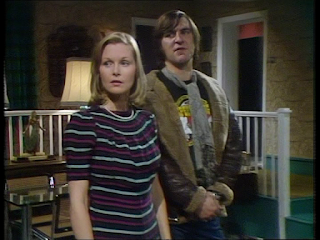
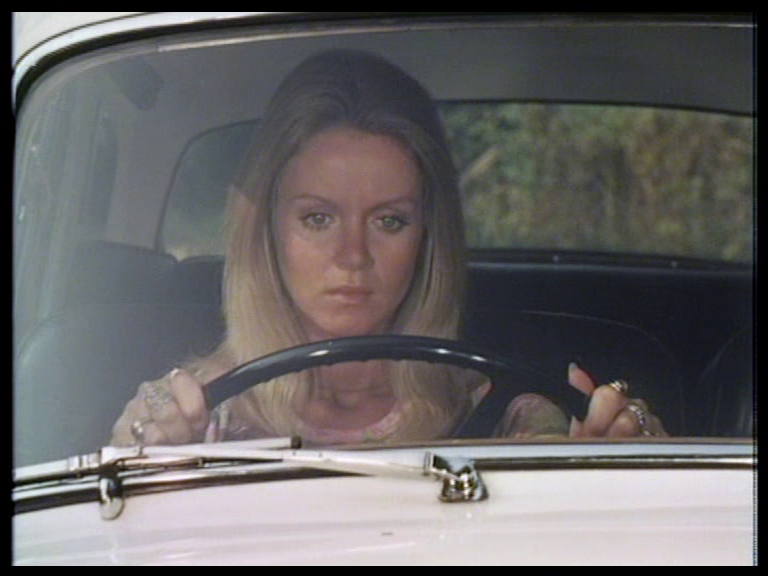
A teenage girl - Annabella Tully - heads happily into a forest on a summer's day only to be stabbed and killed by an unknown assailant. The murder is unsolved after five years so her uncle and guardian, Arnold Tully, visits the office of J. Baxter, a private detective. When he gets there he meets J. Baxter's wife Jody and assumes she is the private eye before she can explain. She takes on the job anyway. Tully tells her that he is convinced that the killer is a local actor called Peter Ingram but there has been insufficient evidence to charge him - her task is to find fresh facts that will bring him to justice. When Jody meets Ingram he immediately makes a play for her and is an unnerving figure but is he also the killer? Jody makes good use of some apparently trivial details mainly related to the interest of Annabella and other characters in Shakespeare and amateur dramatics but her search leads her into danger.

Review

The final series of Thriller had been a little underwhelming so far with only Dial a Deadly Number and perhaps Kill Two Birds rising above the norm. This episode didn't mark a return to stronger form and for a while I considered it my least favourite Thriller but on later viewings its merits have been more apparent; it's still below par by the show's high standards but overall is a flawed but sometimes fascinating and thoughtful production.

The teaser is indicative of the ambivalence it produces. The murder of Annabella, in a very happy mood as she goes to meet her boyfriend, is both poignant but also rather disturbing. She is the youngest victim in the show and one wonders whether this was a good idea. She is not a child but the murder of a teenager is particularly unsettling.

Annabella was the adopted daughter of her unmarried uncle Arnold Tully. Five years later he has a devotion to her bordering on obsession. This obsession, with photographs of her around his house and her bedroom turned into a virtual shrine, suggests a questionable, maybe unhealthy level of involvement. Even the police speculated on whether he might have been her killer. On the other hand - and maybe more reasonably - this devotion might be seen as a response to a terrible tragedy. Loss can make people react in excessive ways - ways that may be misinterpreted by others but which have their own logic.

Annabella came into her uncle's care when her parents were killed in a car crash. This kind of scenario which results in a child coming into the custody of a relative is not uncommon in TV drama and is somewhat unlikely and rather cliched. Maybe this could have been avoided in the story by making him a married man and sharing the sense of loss and devotion with his wife, possibly in a similar way to the Cornfields in In the Steps of a Dead Man. The housekeeper character could have been transformed into his partner. Better still to have had him married and Annabella's natural father. Perhaps the background of deceased parents was done to heighten the sense of loss and tragedy but it seems unnecessary. It may in part have been a product of the tendency then to allocate far more leading roles to men than to women and it may have produced a different and more realistic angle to have had a female character (or a married couple) as the parental / guardian figure who employs Jody.

The attitude towards young women in the story can provoke concern. We are not sure for most of the story of the identity of Annabella's boyfriend but he is clearly a much older man and that always raises question marks. Immediately upon her arrival the young blonde Jody arouses interest from the men and it is a little uncomfortable to watch. Ingram, the chief suspect for Annabel's murder, seems especially predatory. This links to the generally unappealing character of almost all the men in the story. However more open-minded attitudes are also at work. Tully is prepared to accept a female private detective and treats Jody on her merits. He is the one man who doesn't seem to regard her in a sexual way, although once again he gets attached to her in a way that may indicate an undeclared attraction.

References to the stage, acting and Shakespeare are dominant and can become rather wearying. This is not criticism of these themes per se but just the way they are handled. Perhaps if there had been scenes - possibly flashbacks - of the characters including Annabella acting it would have been more effective. The final series saw some experiments in setting - Nightmare for a Nightingale is another example - and these are fairly interesting but not wholly successful.

A curious and not very satisfactory story element is the relationship between Jody and her estranged husband Johnny. There are some good serious points early on as they discuss their lives and potential future. However the injection later of rather weak comedy, notably when Johnny calls her from Italy and a bad line leads to him mishearing her, is ill-advised. The final "tag" scene between them is handled in a lightweight fashion and detracts from a good, if low-key, conclusion to the murder investigation. Tony Anholt is wasted as Johnny and his character could probably have been excised. The serious insights into their relationship are a valuable counterpoint to the atmosphere of loss and loneliness in the main story but the lighter moments really do jar and should have been removed.

The prospect of the pair forming a detective duo though could have had potential if Thriller has moved to another series or been used in a spin-off of some kind. The show had already had a husband-and-wife private detective pairing in K Is for Killing but that had been played in a very light-hearted way (too much so for many viewers if not myself) and maybe the Baxters could have been a more appealing alternative, playing their parts with a touch of humour and some good-natured rivalry while not detracting from the drama.

Much attention has been paid to limitations in the episode but there are real strengths. Tully is an interesting character. The scenes of him reflecting and talking with Jody are melancholy and very effective. Freddie Jones's performance in this challenging role is impressive but the director takes credit as well for the success of these scenes. Ingram initially appears an utterly dislikeable figure. The story very skilfully makes him seem to the obvious, untouchable killer. He protests his innocence but as his case shows a a person doesn't have to be charged, let alone convicted, for the public to decide he is guilty and the court of public opinion can be a harsh one. Jody's conflicting attitudes towards him are well displayed - to succeed in her detective role she does need to deal with him and she shows understandable unease but also fascination and a certain sympathy. Norman Rodway handles this disconcerting character well.

Jody tries to get to know chief suspect Peter Ingram

The climax is well-done and involves not just one but two surprises. The final series largely avoided the dramatic climaxes of before and this is very subdued after at first seeming likely to flare into action. There is a poignancy to events with even a little sympathy for the killer who seems a crushed man. It is testimony to fine writing that the viewer can have these feelings.

Joanna Pettet gives a strong performance as Jody and will be the dominating memory for many viewers. She gives a genuinely affecting display, taking the lead more than in her previous appearance A Killer in Every Corner in which she was also in fine form and across her two appearances she is one of the best transatlantic guest stars She takes a good assertive part, showing how a woman can be a capable investigator. Her desire for independence is another a valuable feature. In other regards she has a fairly conventional role as a heroine who faces danger but doesn't flinch from her enquiries. It is a pity she was saddled with the comic scenes with Johnny and developing further the serious nature of that relationship would have drawn extra dimensions out of the character and the actress.

Overall the episode rewards repeated viewing and has some depth. It's certainly good to see a woman in a private detective role and she has an unusual task in being asked to prove the guilt of a suspect, contrasting well with the earlier The Next Scream You Hear in which the detective was asked to prove his client's innocence. Jody's behaviour also raises some questions as she deceives not just Tully but also the police about her identity, pretending to be a professional private detective when she is not. In a sense she is a fraud like Dave Adams two episodes earlier in Dial a Deadly Number in which he posed as a psychiatrist. However her behaviour - while unethical - is likely to pose much less concern as she wasn't trying to exploit Tully and had better motives, not just in trying to help him but also to prove that she actually had the skills to do the job; also to he credit she does eventually confess her deception to Tully. All these add-up to a thought-provoking and worthwhile outing even if isn't Thriller at its best.

Notes

This was the first Series 6 episode of Thriller broadcast by the ABC network in the USA on 16th September 1975, almost eight months before it first aired in the UK. ABC broadcasts were usually ahead of the UK (especially for Series 6) but this was the most advance screening. It's possible it was selected for an early screening while it was still summer in the USA.


Tuesday, November 9, 2021

The Next Victim - Series 6 Episode 2 (Saturday 17th April 1976)

The story

Sandy Marshall is an American woman married to a successful British insurance agent. She has to use a wheelchair after a terrible accident in which her new sports car crashed. A heatwave has hit Britain but she is less than delighted. She cannot get out of her flat and her husband has gone away on business, leaving her alone. A number of local women have been strangled and she is very anxious. She tries to reassure herself but without success. Her friend Betty offers support and promises to meet her for a drink. However Betty never arrives and Sandy fears the worst. A visit from a personable neighbour, Tom, seems to offer protection - or does it?

Review

The story description above suggests classic Thriller territory and even the title was suitably chilling. Unfortunately the results on screen have generally disappointed viewers including myself although - in common with a number of other "lesser" episodes - I have found it far better than I remembered on more recent viewings. Clearly it does have some limitations but it also has virtues that shouldn't be overlooked

The general viewer feeling is that something seems to be lacking in terms of writing, characters, performances and general direction here. There are virtues such as some particularly good direction early on from the killer's perspective, but there is a lack of consistent quality Maybe the problem was that this was exactly classic Thriller territory and finding new inspiration was difficult. 

The teaser presents a murder and the body count early on is high. This in itself was probably not a promising sign. The best examples of Thriller might have just one or two killings throughout and much more emphasis on suspense and fear. This is a whodunit but the suspects are not so well presented this time and are barely seen after the first twenty minutes. The obvious candidate is the caretaker Bartlett. This figure, very well played by Ronald Lacey, is lazy and indifferent about his work. More disturbingly he has a dominating obsession with mothers and babies, and the police theory is that the killer is "mother-fixated". He is a shabby, deeply unsettling person and the killer dresses similarly in a brown overall and jeans. There is an interesting comparison to be made with the caretaker Murchison in If It's a Man - Hang Up!. Murchison was another obsessive but far more affable and eager to please (and literally smarter!) Maybe this is a sign of this story trying to up the ante and create a more shocking scenario. Sandy's husband Derek and Spiros attract limited suspicion but there is no other significant suspect until the arrival of Tom Packer halfway through. If It's a Man and File It Under Fear a few years earlier applied the whodunit formula far more successfully.

The heroine and prospective victim is a pivotal figure in this sort of drama but Sandy Marshall doesn't make as much impact as her predecessors. A disabled target adds a fresh dimension. Blindness had been examined as a way of increasing vulnerability and lack of mobility opens up new options. Sandy can see danger but she has little chance of escaping from it. She is clearly anxious and understandably so. The character should work extremely well but comes across as a little underwhelming, although there is an improvement in the final part when she is trapped with the man she believes is the killer. Carroll Baker probably had the most prestigious film background of any US guest but that is not necessarily a recipe for a fine Thriller heroine. Possibly we are too used to seeing younger actresses in these roles. Maybe offering a return to one of the most impressive US guests such as Carol Lynley, Skye Aubrey or Lynda Day George would have been the better option.

Sandy (Carroll Baker) faces a terrifying ordeal

The two detectives have a lot of screen time. The intention was to set up a clear contrast between the older, irascible, sarcastic Inspector relying on intuition (Frampton) and the younger, educated, "scientific" policeman (Small). Needless to say the intuitive detective is the one who gets the answers. Decades ago this combination wasn't quite as clichéd as it has now become but it's still a little predictable. Frampton does fit the usual Thriller mould of the quirky investigator. He seems happy to sit back while his junior detective does all the spade-work although appearances are a little deceptive as he is applying some analysis while Small serves up suspects. He does make some darkly amusing asides and interesting observations including that the rush of killings suggests someone who has just "snapped" rather than had long-standing issues. 

Things do improve somewhat with the arrival of Tom Packer. Tom appears to be very friendly and helpful towards the edgy Sandy but she remains disconcerted by him. Tom reveals a deep devotion to his mother, who was also in a wheelchair before her death. This creates a bond of sorts with Sandy but his level of attachment becomes disconcerting. He reveals both intriguing perceptiveness but also lack of tact in the inferences he draws about Sandy's "accident". He makes some provocative points about scams and how accidents often hinge on serious negligence that gets overlooked or condoned.

There is an impressive twist in the climax (perhaps a little rushed) and a certain irony in how things turn out. There is also some good direction as Sandy tries to make an escape in an unconventional but necessary way. In a better story the twist in particular would have received great acclaim but due to the modest overall quality it doesn't make full impact. Following this, the final shot is simply of police and an ambulance stationed outside the apartment block - this should have either been excised or followed-up with the police dealing with events inside. It is indicative of an untidiness which occurs at various points in the story. Other examples are painfully wooden news reports (even worse than those for The Eyes Have It) and a collection of barely-seen, ill-defined characters, most of whom could easily have been removed and one or two developed further. Indeed Harold Bennett (who had appeared in A Place To Die) is credited but does not appear suggesting some editing was going on or some late script changes but if so it seems to have been inconsistent. Perhaps both the script and the filming were rushed or needed better management - whatever the reason these aspects stand out for the wrong reasons. 

Perhaps this would have been much more successful if produced a year or two earlier with the show at its peak. It definitely had strong facets that could have been exploited better. There had rather been a treadmill of production (Series 6 was produced in Spring-Summer 1975 for US broadcast shortly after though not shown in the UK for almost a year) with barely a break for Brian Clemens and the production team and maybe six months or a year away would have refreshed minds and led to some stronger outcomes for the final outings. 

This also proved to be the last of the more traditional Thriller stories. The remainder of the final run saw experimentation in setting or style, possibly because it was felt the traditional formula needed a rest or had gone as far as it could. It is a shame this last "conventional" offering could not have been better.

Notes

It seems odd that the newsreader is not credited despite having a fair number of lines and appearing on screen. 
Unusually for Thriller some stock footage (of holiday traffic and crowded beaches) appears during the news reports.

Harold Bennett is listed as "Blind Man" on the credits but doesn't appear on screen - possibly the only example of a credited actor not actually featuring in the show. This may have foxed the producers of the Australian box set who highlighted him as one of the featured actors, noting his Are You Being Served? fame. This anomaly may reflect the general editing issues with this episode. Quite what part his character might have played is unknown but it's possible it was as a neighbour Sandy frantically sought-out for help only to discover he was blind.

A newspaper report Sandy reads about the murders reads refers to a "lady killer". It seems highly unlikely a genuine news report about murder would have used this flippant term (otherwise used about men who easily attract women) so it's possible this was an in-joke referring back to the first episode Lady Killer. 

Anita Sharp-Bolster was the oldest actor to appear in Thriller, aged almost 90 when this episode was produced in June 1975.

The arrangement of names on the bells outside the apartment block seems to refer to "Martin Marshall" - the writer of A Thriller in Every Corner!


Tuesday, November 2, 2021

The Next Voice You See - Series 5 Episode 6, Saturday 17th May 1975 (ITC movie title "Look Back in Darkness")

The story...

Stan Kay is an American jazz pianist visiting the UK. On a routine call to the bank there is an armed robbery in which his wife is killed and he is blinded. Ten years later Stan returns to the UK and is about to play at an upmarket party. While playing he hears the voice of the robber from the past. He is totally shaken and determined to find him but how can a blind man do this? Unfortunately Stan finds that he is not the only one who is determined to find his man...

Review

Quite deservedly this is one of the most popular episodes. It is a top-class effort - the last script written by Terence Feely (as always from a story by Brian Clemens) and is a splendid farewell.

Blindness had been covered before by Brian Clemens in the film Blind Terror and the first series episode The Eyes Have It (also scripted by Terence Feely). Neither of these is a particular favourite of mine, although Eyes is an improvement on the film and very popular in the fan community. For me this story though is clearly superior to either predecessor. The virtues of both earlier efforts are achieved but the limitations are avoided. Blindness offers great potential for fear and suspense. In The Eyes Have It this is well demonstrated but the fact that the blind students were not themselves the target of the assassins limited the impact. Additionally the students had the benefit of being a group with a strong sense of solidarity which partly subdues the threat. On this occasion Stan Kay is most definitely the target. There are sighted people who can offer help, but no one who is blind and truly understands his perspective. This heightens the level of tension very effectively. In the film the blind Sarah was the target. However the episode avoids the film's pitfalls in which the miseries and terror inflicted on her border on the gratuitous. In general the unattractive goriness of the film is astutely avoided. The most effective thrillers in general are not graphic and the TV series almost always left matters rightly to the viewers' imagination.

Stan has already been through a dreadful experience with the murder of his wife. He was blinded in the same incident. In the intervening ten years he has adapted well - at least on the surface. He is a hugely likeable and talented man. One could understand him being bitter and cynical but he remains positive. However someone who has faced trauma - in this instance a double trauma - may never truly recover. Terrible memories and anxiety can recur. Any reminder can be devastating and that is exactly what he receives when he hears the killer's voice. Maybe only someone with a musician's aural sensitivity could have picked out a stray voice in such an environment. The moment when he makes this shocking discovery is superbly handled on screen. To the assembled guests Stan's loss of composure can appear to be just lack of professionalism or even drug-induced. He has no time though to dwell on his reputation. He is determined to find the man but how can a blind man do so? It's a great scenario but becomes even more powerful. When someone is searching, he might well soon find that the hunter becomes the hunted and so it proves. Very quickly the killer knows he is being pursued and Stan is now in terrible danger.

In addition to the efforts of Stan and the killer to find each other, there is also a fine whodunit. Who is the killer? What would he be doing at a society party? The episode cleverly challenges the stereotype of "the criminal", and "the armed robber" in particular. There is an assumption by Julie which many would share that it is inconceivable that wealthy individuals could be criminals or have a criminal past. However as Stan quite correctly says, "Criminals don't look like criminals these days." Wealth sometimes does derive from crime, and a criminal can buy themselves into apparent respectability. Almost playfully, reference is made to a whole array of characters having dramatically risen to financial success about ten years earlier. However with just a snatch of conversation the viewer is left confounded. When we see the killer in action we only see his shoes (a clear echo of Blind Terror) or his torso so we are none the wiser. Although this is a whodunit it is not a conventional one as the viewer has so many potential suspects (just about every man at the party) and so little to go on.

Only in the later stages is the killer revealed and in a very shocking way - for me one of the most chilling moments in Thriller. This then leads to Stan being sought-out by a particularly odious villain who seems to delight in exploiting Stan's lack of sight and trying to defeat his aural abilities. These scenes are almost painful to watch and there is a particular claustrophobia with the stalking late taking place in a wine cellar. Unlike other Thriller episodes where the villain tries to catch and kill the hero or heroine (the classic case being I'm the Girl He Wants To Kill but A Killer in Every Corner on a smaller scale) there is neither room nor need for chasing but the the tension can be just as great when the search is more slow and deliberate as here. The climax is certainly dramatic, poignant and it defies some of the usual cliches.

Julie (Catherine Schell) offers Stan (Bradford Dillman) a sympathetic ear

Stan is one of the finest characters in Thriller - a man of amazing strength and dignity. He inspires great affection but he is not alone in this respect. Stan's chaperone Julie is very warm and kind and the two are an excellent combination. Despite her initial scepticism she takes Stan seriously and tries both to help him find the killer but also save him from danger. The host Sir Peter also provides a warmth towards Stan that is very welcome. Some of the other attendees at the party are rather less supportive but they provide important contrast with some such as Ludo (played by a young Nigel Havers) coming across as spoiled brats while others are only too ready to suspect Stan's distracted behaviour as caused by being under the influence. The security chief Tamplin is initially abrasive and tactless but he eventually offers support but like Stan he is to find that the cat can become the mouse.

In acting terms Bradford Dillman gives one of the great Thriller performances. Catherine Schell and Geoffrey Chater (Sir Peter, a very different part to the distinctly dodgy, somewhat heartless character he played in The Colour of Blood) give him great support. Ray Smith is always a fine actor and does a sterling job as Tamplin, although his cockney accent is somewhat wayward and would probably have been best avoided. The direction by Robert Tronson is exceptional, especially in the final stages. Laurie Johnson's music if, of course, perfect. All these factors add up to an utterly memorable Thriller.

Notes

This had the largest cast of any Thriller episode with twenty-three credited actors, most of them playing guests at the party.

Robert Tronson also directed Geoffrey Chater in his earlier Thriller appearance.

Monday, October 25, 2021

If It's a Man - Hang Up! - Series 5 Episode 1, 12th April 1975

The story...

Suzy Martin - an American model based in London - seems to have everything going for her. That is until she starts to receive disturbing, threatening phone calls from an unknown man. Suzy's predicament intensifies when her brother Peter is knocked down and killed by a hit-and-run driver; while the police believe it was an accident she is convinced it was a deliberate act by the phone-caller who had mistaken Peter for a boyfriend. The calls do not stop and there seems a real risk of her being physically attacked so a policeman involved in her case called Henry Venner persuades her to spend some time at his country cottage for her own safety. However is Suzy really going to be safe there?

Review

Whichever way you look at it, this is an exceptional episode. It is certainly exceptional in a factual sense. It was the only original story made in an extended format to fit a ninety minutes slot (seventy-five of screen-time).  The original extended version also had its own unique titles and score using strings and brass. However a shorter version using the conventional Thriller music has been available as well in addition to the ITC movie version. As a result it has a complicated history covered more fully in Martin Marshall's excellent book A Thriller in Every Corner.. In terms of quality fans are divided but it probably has more supporters than detractors and in my view it is one of the strongest and most entertaining instalments. The review will concentrate on the extended version, which seems to be the one that aired originally in the UK in 1975 although there's no particular difference in quality between the longer and shorter ATV ones.

Voyeurism is the key subject of this story. Suzy is a model and as such is being observed all the time. As a woman she is aware - and uneasy - about being judged in terms of her appearance. The stalker though is going much further. Not only is he spying on Suzy in her most private moments but he is terrorising her. She knows she is being watched and his phone calls are very frightening. How far will he go? The story focuses on a common fear of women. The heavy breathing and tormenting voice of the stalker even from the start are very disturbing, with skilful direction adding to the fear.

This is a whodunit, and a classic of its type. An assortment of suspects is arrayed very quickly. There are two would-be / ex-boyfriends in photographers Greg and Terry both of whom are angling for Suzy, but how far will they go? The fact that the two see each other as bitter rivals both in a professional and romantic sense adds to the intrigue. The caretaker Murchison perhaps fits the stalker stereotype more closely: a middle-aged man, infatuated with Suzy but clearly out of her league, and already seen to eavesdrop on her. Italian student Bruno has no past history with her but does show an interest. However his attitude seems ambivalent. He remarks on her being "smug" and that she should not live alone: he cannot be discounted. Later the young policeman Henry (or Hal) joins the fray. Hal appears to be very supportive but struggles with anxieties about his disfigured face and relations with women. He is smitten by Suzy but may not be as faithful as he seems. Of course such is the formula that one should doubt whether any of these suspects is the guilty man. In the whodunit the obvious suspect is rarely guilty - or is this one of the exceptions? Innocent or not, none of them inspire total confidence. If it isn't one of them, who could it be? Formulaic it may be but the suspects are still lined-up with great aplomb by Brian Clemens. Excellent suspenseful direction and fine acting makes the results very convincing and satisfying.

Suzy with photographer Terry Cleeves - one of a number of suspects in her case

Carol Lynley does a great job in conveying Suzy's terrible predicament. She does not know with whom she can feel safe. She can no longer live her own life and feels dictated to by her pursuer. She knows he is not a man to be ignored after the murder of her brother. He even cruelly toys with her devotion to her dog Toby. He clearly knows a lot about her and how she can be manipulated.

One of the most fascinating aspects of Suzy is her feminism. Thriller was a very traditional programme and this is the only example of an openly feminist character. Refreshingly Suzy stands up for herself and leads an independent, single life - until the stalker makes it impossible for her. She is assertive in resisting both Greg and Terry and maintains her right to write for a feminist magazine. She picks up on Hal's lazy remark that, "All women are late." In other episodes these sorts of generalised sexist remarks passed uncorrected but not here. There is of course the arguable contradiction about a feminist working as a model but Suzy feels quite correctly that support for women's rights does not have to be at the expense of physical attractiveness. Intriguingly Carol Lynley expressed similar feminist viewpoints and had a similar professional background to Suzy, so it's possible that this influenced the casting or the writing of the part.

Another likeable aspect of Suzy is her open-mindedness. She is a beautiful woman who could pick almost any man but she is happy to consider a relationship with Hal despite his facial disfigurement. She appreciates his personality and supportiveness. The anxiety of Hal about his appearance is though an understandable one, rarely covered in film and TV. In a society obsessed with physical attractiveness someone like Hal can feel neglected and unhappy. She helps to build his confidence but never in a patronising way.

Away from the main story there are some interesting relationships. Betty's play for Greg is notable. She appears to offer him support given his frustrations with Suzy and altercations with Terry. Maybe a romance is on the cards or is Greg still more focused on Suzy and keeping his ex-wife onside? Sue Holderness early in her career makes a strong impression as this enigmatic character. Unusually the policemen featured are constables with no senior ranks involved. The banter between these officers (Richard Lovell and Hal) is also highly engaging - friendly but still with a competitive edge..

The final stages as Hal takes Suzy to hoped-for refuge are very well-done and it soon becomes apparent that Suzy hasn't found a place of safety. The closing minutes are both nerve-racking and poignant and involve so many twists that even at the end one wonders if another one may come. 

Overall Shaun O'Riordan's direction is first-class but the acting performances are uniformly impressive. Gerald Harper was the billed British star but he has very fine support. David Gwillym, always a fine actor, deserves particular credit as Hal - protector or persecutor? In a very small role Michael Cronin will stand out to many viewers as the future "Bullet" Baxter, the very firm but fair PE teacher in Grange Hill. There is a great deal to appreciate here. Probably the shorter version - appearing erroneously as the "official" one on the DVD set - is a little better for the viewer as it is tighter and has the benefit of the superior woodwind score but it is excellent to have the choice of two very impressive versions. The new titles and music produced for the extended version when it premiered also show the very satisfying results that can occur when these are produced at the time by the original creators with the original cast as compared to those added long afterwards by different companies for the ITC movie versions. It is certainly a shame that no other extended editions were made - this one shows there was potential in a longer format even if the standard length probably fits Thriller the best.

Notes

The ITC movie version was the only to be given an on-screen copyright date other than 1974 - here given its correct production date of 1975. All the others were billed as being made in 1974 even though most were made in 1973 and 1975.


Monday, October 4, 2021

The Next Scream You Hear - Series 3 Episode 6, Saturday 6th July 1974 (ITC movie title "Not Guilty")

The story...

Bernard Peel (Christopher George) is an American businessman living in England, married to an exceptional corporate lawyer. He returns home from a party one evening, has a drink and falls asleep. He is woken by the doorbell and is alarmed to find the police. They tell him they have been tipped-off about an incident involving him and his wife. He is utterly incredulous. An inspection of the house shows evidence of a violent incident and of a female visitor but Bernard denies all knowledge. Matters get far worse when the boot of his car is opened and his wife's body is found.
Bernard Peel is shocked to find the scene of an apparent crime - and himself under suspicion by the police

Bernard is arrested by the police for the murder of his wife. He strenuously denies responsibility and calls in the services of the foppish but remarkably skilled private investigator Matthew Earp (Dinsdale Landen). Earp approaches the case with typical incisiveness and is true to his word that he will prove who killed Jennifer Peel.

Review

The third series opened with five quite exceptional stories so maybe it was too much to expect its closing member to match that standard and so it proved. Even allowing for that it is one of the least impressive episodes of Thriller, although it does have its virtues.

The story premise is quite a novel one for the show. The onus is on trying to clear a suspect who the police feel certain has killed his wife, whereas usually stories were either whodunits or made clear the identity of the killer from the start. Of course if Bernard Peel is not the killer the quest is to find the real culprit. Unfortunately the action never really catches fire, maybe because so many of the characters are quite unremarkable. There is no problem with the performances but very few make a real impression. The outstanding exception of course is the fabulous Matthew Earp. Earp was the only character to reappear in Thriller and he is excellent, just as witty and incisive as in An Echo Of Theresa. It has to be said that neither episode was particularly distinguished and both rather need this character's presence although a contrary view might be that it may have encouraged an over-reliance on him which could have been devoted to developing the story or other characters more. There is always the risk that the quality of a star character or actor can be a distraction from the whole  but maybe it was sensed there wasn't enough depth or quality elsewhere so it was best to give Earp such priority.

Dinsdale Landen was made for this role and it would have been useful to see him in further adventures, either within Thriller or elsewhere. Once again he shows not just mental acumen but physical prowess and bravery. There are also some neat exchanges with Gifford (Edward Hardwicke) the detective who quietly resents Earp's involvement as well as his enormous fees.

Matthew Earp (right) with Tulliver, Bernard Peel and Maycroft in happier times at the party before the dramatic events

Of the remainder of the cast Christopher George does a fair job as Bernard Peel. Hans Meyer has a nice part as a director of Peel's business who is clearly suspicious of him and unhappy about being down the pecking order. There is a note-worthy appearance by veteran actor Richard Todd as Tulliver, one of Bernard's colleagues. Suzanne Neve returned in another key role in Won't Write Home Mom - I'm Dead in Series 5 while Belinda Mayne does a nice turn as a rather unhelpful and unenthusiastic shop assistant whom Earp encounters..

The twist at the end is one of the most inventive. In a better episode this would have been a hugely satisfying conclusion but here it's really just the television equivalent of a consolation goal. Judged away from the Thriller context this would be quite good value and the show - even when a little off-form as here - is still well worth watching.

Notes

Gifford applies the handcuffs to Bernard Peel in a fraction of a second, displaying amazing skill and speed.

Christopher George's wife Lynda had been the star of the preceding story Come Out, Come Out Wherever You Are.

ITC Movie title-watch 

1974 was a big year for the martial arts and they make an appearance here, with karate being employed by one assassin. Unfortunately they also make for a very silly piece of art-work on the movie end-titles in which a fist above what is supposed to be Bernard Peel's head (though looking more like Lieutenant Colombo) appears to be pulling his hair! 


Monday, September 20, 2021

K Is for Killing - Series 2 Episode 6, Saturday 2nd March 1974 (ITC movie title "Color Him Dead")

The story...

Tycoon David Garrick narrowly escapes an assassination attempt. He is fairly unruffled by this but his playboy son, Sunny, is very concerned. He recruits unconventional private detectives Arden and Suzy Buckley to investigate. David Garrick is pretty unpopular so there is no shortage of suspects. It becomes evident that the prospective killer has hired professionals to do the job who will ruthlessly eliminate those who frustrate their plans. Who wants David Garrick dead - and why?

Review

The most atypical Thriller episode and among the general fan community the least popular. It's fair to say that this comedy-drama instalment centred on a husband-and-wife, wisecracking, cavalier private detective duo is disliked by most who've seen it but I am in the small minority who has always really enjoyed it. Therefore my very positive review comes with a prominent health warning!

Thriller used humour sparingly. This was a deliberate choice as Brian Clemens had shown via The Avengers a talent for combining drama and humour. Thriller did have occasional funny lines or characters like Hans in One Deadly Owner whose dry humour made them amusing. There were also characters of great wit like Matthew Earp (An Echo of Theresa and The Next Scream You Hear) and Hillary Vance (Night Is the Time for Killing). There is also black humour in episodes such as Murder Motel. However nowhere else is there a comedic style as experienced in this outing. The story premise is certainly not comedic - a wealthy businessman is the target of death threats, but from whom? It could easily have been played as an entirely serious whodunit story and it would have been fascinating to see the results. However Brian Clemens (with assistance from Terry Nation with the concept) wrote it as a comedy-drama.

It's fair to say it is the comedy that draws the hackles of most viewers who feel it just doesn't come off. For me on the other hand it works beautifully and is extremely funny. Maybe the problem for some is context. It carries the Thriller brand and viewers expect it to be in similarly intense vein. Maybe viewers seeing the movie version "Color Him Dead" with no knowledge of a link to Thriller might appreciate it more on its own merits. Of course some of them may not rate it even without the Thriller association. The Thriller formula is an elastic one and could stretch to a more humorous style - as an anthology series it did not have to worry about regular characters acting against type and could explore different styles more readily. The key issue is whether that attempt is made successfully.

On a comedic level it works great for me. Arden and Suzy Buckley are a fine pairing, with so many funny lines and a refreshing sense of abandon. They are also though good at their job, thwarting the attempts on Garrick and ultimately catching the killer. Stephen Rea and Gayle Hunnicutt play these entertaining characters with very good chemistry. Sunny is played with great devilish charm by Christopher Cazenove while his father David is appropriately irascible. The criminal broker Shelby Grafton is splendidly handled by Derek Francis - there is general agreement even among sceptics that he is one of the highlights of the episode. The hapless informer Charley White is played almost wholly for laughs and is nicely conveyed by Arthur White. It does say something for the light-hearted style that even Charley's murder is the subject of wisecracking rather than horror. David Garrick's unfaithful girlfriend Mrs. Gale (perhaps a nod to The Avengers and played by Honor Blackman-lookalike Frances Bennett) is another delight, as is the northern hitman who polishes off Charley. It's notable that many of the actors used in this episode were very comfortable with comic and lighter roles which suits the style here but if a more serious version had been attempted quite a few roles may have been recast.

Unconventional private detectives Arden & Suzy Buckley (Stephen Rea and Gayle Hunnicutt)

For all this the drama is not overlooked. The unhappy relationship between Garrick and Sunny is all too real. Garrick has given his son little but money but Sunny has squandered so many advantages - a scenario that exists in many families. The character of Mrs. Garrick though offers the greatest drama. She has mentally collapsed and switches between childish innocence and fearsome bouts of anger - and then back again. Maybe if more use of her role had been made some of the critics might have been appeased. Either way it is a tremendous performance by Jean Kent.

The drama does not go on too long here with the production generally trying to keep matters light. This means for example that even the killing of certain characters or threats to their lives are met quite flippantly in a way that some viewers may feel is hard to take but works for some. As a lighter episode it's not too surprising that it ends on a light-hearted upbeat scene which is a little sickly but okay in this context whereas some attempts to lighten the tone at end of more serious stories (e.g. Kiss Me and Die) jarred rather more. 

There was no return to a production quite like this again. Maybe Brian Clemens and the producers felt it hadn't really worked, or perhaps they were happy with it but believed one such story was enough. Murder Motel at the end of Series 5 saw the return of Derek Francis and had some comic elements but in a more subdued - and rather ineffective - style. Whatever one's opinions on this episode it does at least provide plenty of talking points and hopefully there are others out there who enjoy it.

ITC movie title-watch

The end montage wrongly shows Suzy riding the scooter on which Arden hitches a lift. The new title "Color Him Dead" (using the American spelling of "colour
") perhaps unsurprisingly was assumed to be a spelling mistake by many British newspapers and was "corrected" to "Colour Him Dead". The new title is also one I have to take a few moments to connect it to this episode as it is a very generic title that could refer to various episodes while the American slang use of "color" might be lost on many viewers outside the USA. Better movie titles would have some link to the storyline, e.g. "Death in Small Doses" (the new title for Ring Once for Death) does suggest the villain's mode of killing.

Thursday, September 16, 2021

One Deadly Owner - Series 2 Episode 4 (Saturday 16th February 1974)

The story...

Model Helen Cook is on the way up but her impulsive decision to buy a white Rolls Royce she can barely afford seems peculiar but she felt she "had to have it". Soon after buying it though strange things start to happen. She hears a scream from inside the car and the car drives itself to a remote location far from her intended destination. This and other evidence lead to her to believe the car is somehow connected with a murder but her photographer and boyfriend Peter believes it's all in her imagination and that overwork is leading her to a nervous breakdown. She does investigate with the previous owner - a tycoon called J.P. Jacey. Mr Jacey is rather world-weary and unsettled after his wife disappeared three months earlier. Despite this he hasn't called the police, apparently because she may have left him for another man but maybe there is a more worrying reason for her departure.

Helen Cook (Donna Mills) starts to notice something is very wrong with her car

Review

This is one of those instalments that sharply divides viewers - a huge favourite of some, one of the worst for others. I am very much one of its supporters and it is a contender for my favourite episode, and has been since I first saw it in 1994 on the second ITC video released. Thanks to that video release this will be a contender alongside Someone at the Top of the Stairs for the episode I have seen the most.

One of the oddities was that this was the only outing released on video in its movie format. This was entirely a mistake as the ATV version was available and indeed was broadcast by Bravo in 1996. Some viewers like myself skipped the Bravo repeat assuming the same version would be shown and therefore missed seeing the ATV original until it was released on DVD, Dolphin did quite a decent job on the new titles, with some astute use of clips. The new music ("Gear Shift" by Dave Richmond) was good and worked well. The original teaser, making clear that Mrs. Jacey had been murdered and her body transported in the boot of the Rolls Royce, though was completely excised - the only instance of a whole teaser being removed in the ITC versions. These sorts of cuts are never popular and the teaser was a strong one. Fans feel unhappy about the American producers adding their own "scenes" or animation but cutting from the original, which should be preserved intact, is a step too far. However one consolation of its disappearance, and maybe the logic of Dolphin, is that it created extra mystery about the fate of Mrs. Jacey until the final minutes, although the viewer would always suspect she had been killed. The DVD release though now means that viewers can see both openings.

The story is suitably unsettling and mysterious. Donna Mills became the first star to return to the show and deserves great credit for her performance - a classic Thriller heroine display. Her character generates a lot of affection. The interplay with Jeremy Brett as her partner and arch-sceptic Peter is very impressive. Again the sceptic role is a commonplace one, especially in the supernatural tales, but it is brought off extremely well. The exact nature of the relationship between him and Helen is never wholly clear. They are definitely professionally involved and probably romantically so as well but there is tension. Although much of this resolves around Helen's preoccupation with the car there are also arguments over her desire for independence and this friction creates another dimension to the story. 

This becomes one of the Thriller whodunits with various characters having had previous relationships with Mrs Jacey and seeming to have a motive for killing her. Writing and direction work well to pour suspicion on these figures but they are fine characters in any regard. J.P. Jacey's relationship with his wife leaves many questions unanswered and he appears to be a man with much going on under a very reserved exterior - including maybe a fancy for Helen. Freddy appears to have been another lover of the missing Mrs Jacey and while he seems to be helpful towards Helen can he really be trusted? His open-mindedness provides a neat balance between Helen's suspicions and Peter's scepticism, as does his warmth with Jacey's reserve. He is another of the Thriller charmers with an obvious attraction for Helen but it's suitably reined in on this occasion. Even Hawkins, the very proper butler, looks as if there might be more to him than meets the eye. However it is Hans who steals the show. He is a funny character but in the best style of the show he also exhibits menace and mystery (another former lover of Mrs Jacey as well as a business rival of her husband), and one never feels he is merely a comic diversion. There are a number of fine acting displays but Eric Lander in this role is excellent. 

The final fifteen minutes of the show are tremendous. Great use is made of darkness, contrasted with light from the car or a torch, to create a very creepy atmosphere. The pieces start to come together and the suspects start to move in. The final shot, of Helen's car back up for sale - with the viewer left to speculate on whether its "possession" has now been purged - is a fine resolution to this memorable outing.

Helen Cook finds herself in the spotlight in more ways than one


Tuesday, September 7, 2021

File It Under Fear - Series 1, Episode 8, Saturday 2 June 1973

The story...

A number of women have been found strangled in a small town. A frightening situation but librarian Liz Morris feels especially on edge and the police are making little headway. When one of Liz's colleagues Gillie goes missing and only her shoe is found everyone fears the worst. Liz though feels she knows who is responsible and takes matters into her own hands...

American airman Gerry Masters is spying on someone through the bookcase - but who and why?

Review

For me this is one of the best episodes of Series 1 and certainly my favourite of its "straight" crime thrillers (i.e. non-supernatural) although it's fair to say that most viewers plump for either The Colour of Blood or The Eyes Have It; this episode though has always been well-regarded in the fan community, and would be close to my top ten overall. 

This is another serial killer tale but this time a "whodunit" - the first one broadcast, perhaps surprising given the popularity of the whodunit style. The suspects are well-set up. There is the socially inept library assistant George who often feels belittled by the women around him and who seems anxious to prove his masculinity. The pleasant but lugubrious divorcee Steve who lodges with Liz and her mother and who goes out in the evening for no clear reason. Finally we have American airman Gerry Masters who was having an affair with one of the murdered women and whose reading choices show an alarming interest in violence. This was one of numerous Series 1 episodes with no American guest star / lead character and the inclusion of the latter (played by British-based US actor Richard Pendrey) ensures that an American angle is retained which was considered important for transatlantic appeal. 

The episode also has much to say about anxiety, loneliness and insecurity. Liz and her colleague George are both very insecure individuals with George in particular a deeply unpopular young man who often feels (justifiably) rejected and derided; unfortunately he then tends to compound that by antagonising others which leads to him being further baited. With these two we see what can happen when individuals let their pride race ahead of the and a trivial dispute gets completely out of hand. The characters are well-drawn although Liz's comments about "young people" seem odd given the relative youth of her character and a point remarked upon by Sergeant Truscott.  Maybe an older figure was originally conceived for the role but it does help to paint the picture of someone feeling divorced from their generation and somewhat "old before their time".

Liz (Maureen Lipman) & George (Richard O'Callaghan) at odds again

The two featured detectives fit a common Thriller pattern with an irascible senior and a rather put-upon junior. The latter is often drawn more sympathetically but on this occasion neither plays the "good cop". While both are polite to Liz they mock her behind her back and clearly believe that she is "frustrated" and a fantasist. Senior detectives also often had a quirk about them and in Superintendent Cramer's case that is an obsession with golf. Even after he had learned about the first murder he changes the subject back seconds later to his annoyance about a golf game. Neither officer is particularly insightful or admirable but this wasn't unusual for Thriller where police officers and detectives were not necessarily painted as the brilliant minds and heroes as they were in many other productions. 

There are many great performances. Maureen Lipman, George O'Callaghan and John Le Mesurier are in particularly fine form as Liz, George and Mr Stubbs and there is an impressive early appearance by Jan Francis. A number of these actors (Le Mesurier most notably) had long associations with comedy but all prove their dramatic potential here.

Another interesting theme is the interest of Liz's mother in reading about the murders and her tongue-in-cheek remark that "everyone likes a good murder". While a seemingly macabre comment there is no doubt that many people are fascinated by the topic, reading about news stories of murder as well as crime novels and of course watching dramas like this one. 

The final fifteen minutes or so of the episode are exceptionally good. There are two confrontations (one with disastrous consequences) and the final scenes where the truth is unveiled are excellently done with one involving a phone call one of the most terrifying in the history of the show. The final lines are perhaps a little troubling and these combined with the very last shot offers some mystery about long-ago events involving Liz. Altogether a fine instalment and certainly one of the highlights of Series 1.

Notes 

Design was often a strength of Thriller and the library set is especially fine in this episode - so convincing that many viewers thought it was filmed in an actual library rather than a studio set, The exteriors of the library were shot on location but Thriller did little filming on location and almost all that was done were shots of exteriors and brief scenes around them rather than filming inside real locations as later became common.

A box of UFO sweet cigarettes (below, behind George) can be seen in the sweet shop - perhaps the only example of a TV-related product seen in Thriller. 


ITC movie title-watch

The opening titles have attracted some criticism for apparently "identifying" the killer. The eyes of a man can be seen spying on a young blonde woman in a library. This then leads into the murder in the original ATV teaser. It certainly seems very unlikely that the movie producers wanted to indicate the killer. They were probably trying a different angle to the usual silhouettes and headless figures used to symbolise killers in these titles. However it is a risky strategy as it may seem to give clues as to the killer. How many viewers though would pick this up on first viewing is uncertain. Leaving this aside, these are quite effective, suspenseful if maybe a little voyeuristic (as was often the case with the new titles) and the music is very well-chosen. This is one of the few movie versions that ends on a still frame, in this case of the eyes of the "killer" borrowed from the new titles rather than a painted montage. These still images always seem far better to me than the garish and commonly unrealistic artwork on most of the end titles.

Film-Rite's trailer for this movie curiously includes no action from the original ATV version and instead reproduces its own filmed titles, with no voiceover. This could have misled viewers into believing it was a preview for a film made in the USA rather than a British videotaped production.            . 

The American influence on Thriller

Although Thriller was a British TV series one of the most striking aspects is the strong American influence upon the show. indeed this was ...