A businessman checks into a hotel. Soon afterwards two men enter his room and stab him to death while he is in the shower. While all this occurs the hotel manager Sam seems aware and regards it with utter indifference. Later Michael Spencer - an accountant - takes a room there while he investigates a possible fraud. He soon disappears to the consternation of his sister Helen who just has time to inform his fiancée Kathy before she too is confronted. Kathy comes looking for Michael and becomes embroiled in a tale of financial skulduggery and organised murder.
Review
Generally this has been one of my least favourite Thriller episodes and it's fair to say it has been seen by most viewers as a disappointing affair and its supporters are few and far between. However I must say on a very recent viewing I really enjoyed it and not in an ironic "so bad it's good" fashion. I'm always wary of radically revising conclusions and maybe next time I'll find it very disappointing again. What can be said is that there are definite virtues on show but there is one huge issue which may be decisive for many viewers and greatly spoil its credibility. Even in that instance though it's fair to acknowledge the strengths elsewhere.
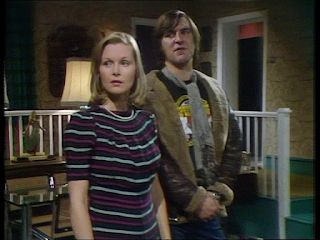
The most glaring problem is the performance of Robyn Millan as Kathy. Of all the central parts in Thriller hers is without question the least convincing display. She seems very unfocused, appearing dazed - "half-asleep" is a common opinion - and literally staggers late in the episode. Her character has had a terrible shock with the mysterious disappearance and ultimate death of her boyfriend - but the performance can't be seen as a convincing screen attempt to convey shock and grief.
in fairness to Robyn it is now known that at the time of production she was under the influence of painkillers she had been taking following a car accident and so it was genuinely difficult for her to give a good display. However that raises the question of whether production either should have been delayed until she was in better shape or a different actress used to take over her part. Given the economics of production a delay - except maybe of a few days - was probably not an option so recasting the role would have been more realistic. Recasting a role at short notice isn't easy but it does seem to have happened with the first episode into production The Colour of Blood when the original actress to play Julie - the female lead - had to be replaced due to illness. This may have been problematic with an American guest star (although it's possible the original actress for Colour was American) and maybe the difficulties emerged too late for a replacement to be used. What is undeniable is that Robyn attracts the viewers' attention but for the wrong reasons. There is no doubt that such a literally shaky performance detracts credibility from the episode although how much is in the opinion of each viewer. The other actors to their credit seem unfazed in their performances and that does help to shore-up events on-screen.
 |
| Kathy (Robyn Millan) finds herself in a terrifying predicament |
There are a number of echoes of Hitchcock - notably the murder in the shower, some angry birds and the use of dark humour. The concept of a hotel where guests are sent to be murdered is certainly an unlikely one. However it isn't totally implausible and within a production with elements of black humour like this a greater departure than normal from realism is acceptable. It must also be borne in mind that only two weeks earlier in Good Salary - Prospects - Free Coffin there was focus on an establishment where individuals were sent to be killed so it wasn't an entirely novel idea even for Thriller.
The black humour isn't overdone and generally works well except at the very end. Sam and his killers regard killing as if it were any job. They go through the motions and treat murder as routine. When Sam asks Roscoe and Terry to carry out another killing the two are irked in the same way as someone asked to do a little extra overtime. They bargain over the terms of contract killings in the way staff and customers might do over the price of an item. All this is done well. It isn't blatantly light-hearted in the manner of K Is for Killing but still raises a wry smile. There are also some funny lines - again in the style of black comedy - such as Sam's remark about one victim calling at "an inopportune time".
On a dramatic level there are some very tense scenes squarely in Thriller tradition. The killings are all handled well. The silent and expressionless approach of Roscoe and Terry makes them extremely unsettling, as does Sam going about his everyday business impassively while he knows they are at "work". A silent confrontation in a phone box between a frantic Helen Spencer and a chilling Roscoe is very well-done. Later an encounter between Sam and someone offering a potential threat to the enterprise is very strong. There are plenty of tense moments and good direction.
Oddly the ostensible star Ralph Bates disappears after just twelve minutes. This is the quickest exit for any star and leaves his character Michael largely undeveloped. Ralph Bates is the sort of prolific actor with a background in the genre who could easily have appeared in any Thriller episode so it has been speculated whether casting an actor called Bates in a thriller about a motel with various Hitchcock references was deliberate as part of the homage. Even if that is so it does seem unfortunate that he had such limited screen-time. Of the other characters hotel manager Sam is certainly a darkly comic figure and very well-played by Derek Francis. The private eye Lee is an excellent inclusion and especially enigmatic. When speaking to Kathy he offers the scepticism heroines often received from investigators but he does agree to help. He then proves himself to be a very clever if rather ambitious operator. Allan MacClelland's splendid acting contributes to a memorable character and one wishes rather more could have been made of him. Another intriguing character is that of the secretary Janice, skilfully depicted by Gillian McCutcheon. Once again though this strong part is too little developed.
The climax has some dramatic qualities but also limitations including a fall by a character that seems unintentionally comic rather than dramatic. However it is the very silly final shot that lets it down - the only case where the black humour overbalanced and damaged credibility. Overall this is a flawed episode but perhaps rather better than its lowly reputation deserves. It would certainly have been interesting to see the results with a stronger lead actress - maybe even if Robyn Millan had just been in better health and able to give a sharper performance - but for all that it still stimulates plenty of talking points.